If you’re searching for the best AI summer camps for teens in 2026, here’s a quick overview of top programs offering hands-on learning in AI, machine learning, robotics, and more. These camps cater to various skill levels, budgets, and interests, ranging from free, prestigious programs to flexible virtual options. Here’s what you need to know:
- CodaKid Virtual AI Camps: Online, flexible schedules, starting at $29/month for self-paced courses. Covers Python, TensorFlow, and project-based learning for ages 6–18.
- iD Tech AI & ML Camp: Week-long sessions at over 75 locations, starting at $1,199/week. Includes partnerships with NVIDIA and CrunchLabs for ages 13–17.
- Integem AI + Robot Design + AR Camps: Combines AI, robotics, and augmented reality. Weekly tuition ranges from $589–$729 for ages 10–17.
- MIT Beaver Works Summer Institute: Prestigious 4-week hybrid program, free for families earning under $200,000. Focuses on advanced AI topics for grades 9–11.
- Carnegie Mellon AI Scholars: Fully funded 4-week residential program for rising seniors. Includes AI research and college prep workshops.
Quick Comparison (Best AI Summer Camps for Teens)
| Camp | Cost | Duration | Format | Ages/Grades |
|---|---|---|---|---|
| CodaKid | $29–$249/month | Flexible | Online | 6–18 |
| iD Tech | From $1,199/week | 1 week+ | Online & On-site | 13–17 |
| Integem | $589–$729/week | 1–3 weeks | Hybrid | 10–17 |
| MIT Beaver Works | Free–$2,400 | 4 weeks | Hybrid | Grades 9–11 |
| Carnegie Mellon Scholars | Free | 4 weeks | Residential | Grade 11 |
These camps offer diverse opportunities for teens to develop AI skills, tackle real-world challenges, and prepare for future STEM careers. Whether you’re looking for affordability, flexibility, or prestige, there’s a program to match your needs.
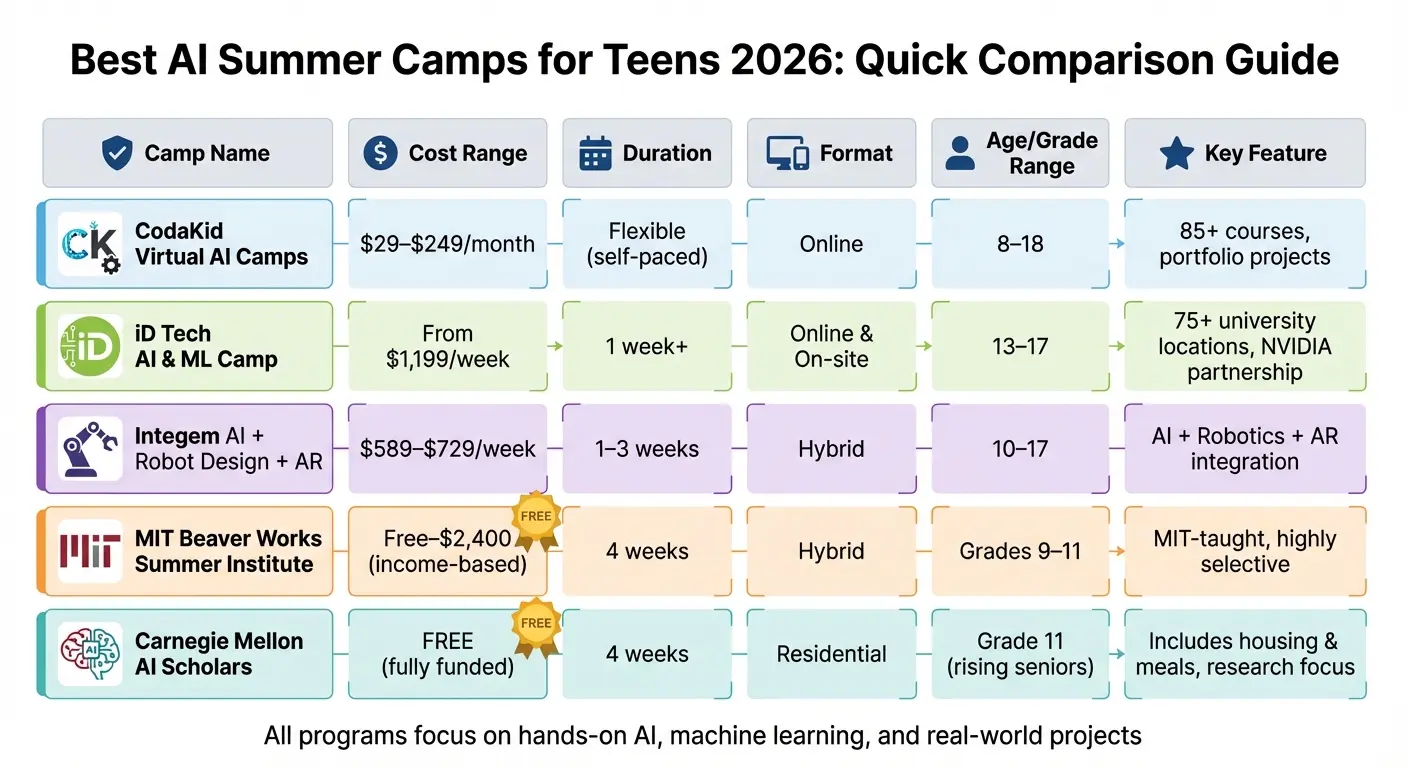
Best AI Summer Camps for Teens 2026: Cost, Duration, and Format Comparison
Table of Contents
1. CodaKid Virtual AI Camps
Curriculum Highlights (Best AI Summer Camps for Teens)
CodaKid’s virtual AI camps take coding education to the next level by teaching teens how to build real-world AI applications with professional tools. Using a “Vibe Coding” approach, students collaborate with AI as a coding partner to design, debug, and refine their projects. They gain hands-on experience with tools and programming languages like Python, JavaScript, Java, TensorFlow, and the Gemini API.
The program’s project-based learning includes creating AI-powered games such as Rock Paper Scissors and RPG adventures, along with chatbots and multilingual virtual assistants. These projects are designed to be portfolio-ready, giving students tangible proof of their skills. With over 100,000 students served and a 4.9 out of 5-star rating from more than 350 reviews, CodaKid has earned accolades like the Parents’ Choice Gold Award for Best Coding Solution.
Cost Range
CodaKid offers flexible pricing options to accommodate different needs and budgets:
- Self-paced courses: Starting at $29 per month, providing unlimited access to over 85 courses.
- 1:1 lessons: Starting at $249 per month for personalized instruction.
- Virtual camps and AI Academy: Around $447.99 per program for intensive one-week sessions.
Families can also benefit from the “Give $100 – Get $100” referral program. As one parent, Ci Tro, shared:
A huge plus for busy parents is the outstanding and swift support from CodaKid. Friendly, expert support keeps students progressing.
Duration and Format
CodaKid offers a variety of session lengths to fit different schedules. Options include 2-day workshops (2 hours per day) focused on tools like Cursor or YOLO, and a 12-week AI Academy covering topics such as ethics, web development, and game design. All live sessions are recorded for later review, and students have 24/7 access to the learning platform and technical support between classes. Instructors are top-tier, coming from prestigious universities like Stanford, Caltech, and NYU.
Age and Eligibility
CodaKid’s programs are designed for learners aged 6 to 18, with workshops tailored to specific age groups for targeted learning. For example, “Vibe Coding” sessions are ideal for ages 12–15, while Machine Learning workshops focus on ages 11–14.
Locations
CodaKid’s fully online format makes its programs accessible from anywhere, eliminating travel costs and scheduling conflicts. This virtual setup ensures students receive high-quality instruction comparable to in-person programs. The self-paced option includes over 800 hours of projects and 750+ instructional videos, allowing year-round flexibility for learning.
2. iD Tech AI Summer Camps
Curriculum Highlights (Best AI Summer Camps for Teens)
iD Tech brings its 25 years of STEM experience to the table, offering teens an engaging summer camp focused on AI. Partnering with NVIDIA, the program dives into machine learning, deep neural networks, and AI model training. Students get hands-on experience “feeding” data – like images – into models to perform specific tasks, such as object detection. By the end of the camp, participants can create their own AI-driven projects.
The emphasis on project-based learning makes this program stand out. For instance, at a recent camp, 16-year-old Nolan T. developed an AI program capable of analyzing a steak’s doneness – rare, medium, or well-done – just by examining a photo. Nolan summed up his experience with AI by saying:
AI is not something to be scared of. It’s a tool. It’s not something we should work against – it’s something we need to work with.
Cost Range
Flexible payment plans start at $375 per installment. Families can take advantage of several discounts: up to $150 off on-campus camps and academies, $100 off virtual camps, or $40 off private lessons using promo code BUILD. There’s also an automatic $50 discount for each additional course registration. Through the Refer-a-Friend program, both parties earn a $25 credit, and scholarships are available for the 2026 season.
Duration and Format
iD Tech offers a variety of formats to fit different needs, including on-campus day camps, overnight academies, virtual camps, and private online lessons. For older teens (ages 15–18), the AcademyNEXT tech bootcamp provides a more intensive learning experience. The curriculum, developed with NVIDIA, focuses on AI, while a partnership with Mark Rober’s CrunchLabs adds an innovation-driven edge to the learning experience.
Age and Eligibility
The programs cater to students aged 7 to 19, with specialized tracks tailored for teens interested in diving deep into machine learning and artificial intelligence.
Locations
iD Tech’s on-campus programs are hosted at over 75 prestigious universities across the U.S., including Stanford University. For those unable to attend in person, virtual camps and private lessons offer the same high-quality curriculum, ensuring accessibility for all students.
3. Integem AI + Robot Design + AR Summer Camps
Curriculum Highlights (Best AI Summer Camps for Teens)
Integem’s summer camps combine robotics and holographic augmented reality (AR) into a dynamic three-week program. Students advance through three stages: “Smart Scout”, focusing on obstacle avoidance; “Mecha Rover”, featuring mechanical arms and Mecanum wheels; and “AI Commander”, which introduces voice-controlled decision-making. Using Python, participants program their robots to handle voice recognition, process sensor data, and navigate digital environments like virtual galaxies or underwater worlds. The program incorporates advanced hardware, including Raspberry Pi PicoW, ESP32 chips, and NVIDIA AI platforms. For those in advanced tracks, Integem offers the opportunity to earn NVIDIA AI certifications and school credits through its WASC accreditation.
Fifteen-year-old Zachary T. reflected on his time at the camp:
I am proud that I can code my own AI-powered Holographic AR with Robotics control at the Integem summer camp.
These hands-on learning experiences are offered at competitive weekly tuition rates.
Cost Range
Weekly tuition costs range from $589 to $729, depending on the student’s age and program length. Specifically, tuition for ages 8–10 is $589–$709, while ages 10–14 pay $629–$729. Extended care from 3:00 PM to 5:00 PM is available for an extra fee. Early registration with the coupon code “SUMMER” provides discounted rates. Integem also supports families with a Scholarship Matching Program and offers discounts for military families, first responders, teachers, and medical professionals. Additionally, the camps qualify for Dependent Care FSA and childcare tax benefits.
Duration and Format
Integem offers a variety of scheduling options to fit families’ needs. Day camps run for one, two, or three weeks from 9:00 AM to 3:00 PM. The Advanced AI Robot Design & AR Coding course spans three weeks and maintains an 8:1 student-teacher ratio. Camps are available in-person at California locations or online through private one-on-one lessons. For teens aged 11 and older, Integem also provides a year-round Tech Leadership program. This program, available for $599 (alumni rate), allows participants to serve as Teaching Assistants and earn the U.S. Presidential Volunteer Service Award.
Age and Eligibility
Integem’s programs cater to students in grades K–12 (ages 5–18), divided into age groups of 5–8, 8–10, 10–14, and 14+. The curriculum is rooted in Stanford University Design School’s “Design Thinking” methodology and has reached over 200,000 students across more than 20 countries.
Locations
In-person camps are hosted at 15–20 locations throughout California, including the San Francisco Bay Area and Greater Los Angeles/Orange County. As an official NVIDIA AI Training Partner and a College Board–approved provider for AP courses, Integem delivers enriching on-campus experiences while also offering private online lessons for remote learners.
4. MIT Beaver Works Summer Institute
Curriculum Highlights (Best AI Summer Camps for Teens)
The MIT Beaver Works Summer Institute offers hands-on, project-based courses where students tackle real-world problems using AI. One standout track, Autonomous Cognitive Assistance (CogWorks), dives into machine learning and data science, focusing on audio, vision, and language modules. Students work with tools like Python, git, and VSCode. Another course, Medlytics (Medical Analytics), trains participants to use convolutional neural networks and support vector machines to predict hypothyroidism, classify sleep states, and identify cancer in mammography images.
In the Games Development with AI track, students explore ethical dilemmas through simulations, such as disease outbreaks and self-driving car scenarios. The Remote Sensing for Disaster Response course applies deep learning and network science to analyze satellite images, while the RACECAR Autonomous Systems track challenges teams to program robots capable of zipping through a Mini Grand Prix at speeds up to 40 mph. Capstone projects, like simulating hurricane scenarios and presenting findings in press conferences, tie the program’s lessons to practical applications. Over 80% of participants reported using knowledge from multiple academic areas during the program. These courses provide students with hands-on experience while addressing real-world challenges.
Cost Range
Tuition is determined by family income. Families earning less than $200,000 annually can attend tuition-free, while those above this threshold pay $2,400. Online prerequisite courses are available at no cost, but students must cover their travel, housing, and meal expenses, as the program does not provide residential accommodations. For in-person attendees, an adult must accompany the student for the entire July session.
Duration and Format
The program lasts four weeks, running from July 7 to August 3, 2026. Classes are held Monday through Friday, with virtual sessions scheduled from 10:00 AM to 6:00 PM EDT and in-person sessions from 9:00 AM to 5:00 PM EDT. Students must complete mandatory online prerequisite courses, which become available in early February, before applying in March. The program is offered in both virtual (via Zoom) and in-person formats, catering to a wide range of students.
Age and Eligibility
This program is tailored for students eager to engage in advanced STEM learning with a focus on AI. Geared toward rising seniors (students finishing their junior year), it accepts applicants in grades 9–11. However, current seniors, college students, and those below 9th grade are not eligible. Participants must live in the United States, attend a U.S. high school in person, and remain in the country during the July session. Admission is competitive, based on performance in prerequisite courses, technical skills, three short essays (500 words or less), and a teacher or mentor recommendation, which is due by April 3. Students are also required to have their own laptop and internet access.
Locations
In-person sessions take place on the MIT campus in Cambridge, MA, while virtual courses are conducted online via Zoom, allowing students from across the country to participate. Since its launch in 2016, the program has grown to include 13–14 courses and now accommodates over 350 students each year.
5. Carnegie Mellon AI Scholars Pre-College Program
Curriculum Highlights (Best AI Summer Camps for Teens)
Carnegie Mellon’s AI Scholars program kicks off with a month-long virtual Python course. This blend of live sessions and self-paced learning ensures students are ready for the on-campus experience, where they dive into key computing and AI concepts taught by CMU faculty. It’s worth noting that Carnegie Mellon is ranked #1 for Artificial Intelligence in the U.S.
The program focuses heavily on hands-on research. Students get to work on active projects led by CMU faculty and graduate researchers, giving them a taste of cutting-edge developments in AI. Beyond the classroom, group projects encourage participants to tackle practical challenges, while field trips to top tech companies provide a glimpse into potential career paths and industry trends. The experience wraps up with a capstone symposium, where students present their group projects – showcasing the skills they’ve gained and how they relate to real-world AI research. Additionally, the program includes workshops on college preparation, covering topics like essay writing, financial aid, and strategies for academic success.
Cost Range
Here’s the standout feature: the program is completely free. Sponsors and donors cover tuition, housing, meals, and select field trips. There’s no application fee or enrollment deposit required. For families who might struggle with transportation costs, travel assistance is available. While optional, students may want to bring $250–$350 for personal spending during their stay.
“The program not only challenged me academically but also provided valuable learning experiences and chances for personal development, fueling my interest in computer science and AI.” – Eli T., AI Scholars 2024 Participant
Duration and Format
The program runs for four weeks, from June 20 to July 18, 2026. It’s a fully immersive, residential program, meaning students live in CMU dorms for the entire duration. This setup allows participants to fully engage in research, collaborative projects, and campus life, making it an enriching experience for high school students.
Age and Eligibility
The program is open to rising high school seniors (current 11th graders) who are at least 16 years old by June 20, 2026, and are U.S. citizens or permanent residents. Priority is given to students from underserved or under-resourced communities, including first-generation college applicants and those with financial need. Applicants must provide supporting documents like tax forms or a signed NACAC Application Fee Waiver. Students lacking access to computer science education or reliable internet are also encouraged to apply, even if they don’t meet the typical financial criteria.
Locations
All activities take place on the Carnegie Mellon University campus in Pittsburgh, Pennsylvania. Students will have access to CMU’s state-of-the-art facilities throughout the program.
What Parents Should Know About Today’s Tech Focused Camps
Pros and Cons (Best AI Summer Camps for Teens)
Choosing the right AI camp involves weighing the unique advantages and challenges each program presents. Here’s a closer look at the key points for each camp to help parents and teends make an informed decision.
CodaKid Virtual AI Camps stand out for their flexibility and affordability, offering self-paced courses starting at just $29/month. With access to over 85 courses on AI and Python, students work with real programming languages and professional tools, making it a great option for independent learners. However, the self-paced format demands a high level of self-discipline and motivation, which may not suit everyone.
iD Tech AI and Machine Learning Camp combines accessibility and flexibility with week-long sessions hosted at over 75 university locations. The program partners with industry leaders like NVIDIA and CrunchLabs to provide hands-on learning experiences, catering to students of all skill levels. While this camp offers a lot, its weekly cost can be steep. Flexible payment options are available, though, and the program has earned a solid 4.4/5-star rating.
MIT Beaver Works Summer Institute (BWSI) is highly regarded for its prestige and affordability. Many students attend for free, and the courses are taught by staff from MIT Lincoln Laboratory. However, the program is extremely selective, making it accessible to only a small group of applicants.
Carnegie Mellon AI Scholars offers a completely free experience, covering tuition, housing, and meals. It provides an exceptional opportunity for rising seniors from underserved communities to engage in AI research. That said, eligibility is limited to specific criteria, which restricts its availability.
Integem AI + Robot Design + AR Summer Camps provide a broad technological experience by integrating AI with robotics and augmented reality. This interdisciplinary approach is ideal for students exploring multiple tech fields, but the trade-off is a less focused exploration of AI compared to other camps.
Quick Reference Table
To simplify the comparison, here’s a quick-reference table summarizing key details of the best AI summer camps for teens:
| Camp | Cost Range | Duration | Format | Key Strength | Main Limitation |
|---|---|---|---|---|---|
| CodaKid | $29/month (self-paced) to $249/month (1:1) | Flexible | Virtual | Affordable, self-paced access to 85+ courses | Requires self-motivation |
| iD Tech | Varies (discounts available) | 1 week+ | Virtual & On-campus | 75+ locations, industry partnerships, flexible options | Higher cost-per-week |
| Integem | Varies | Varies | Hybrid | Multi-discipline exposure (AI, robotics, AR) | Less specialized AI focus |
| MIT BWSI | Free for many | 4 weeks | Hybrid | Prestigious, MIT-taught, cost-effective | Extremely selective |
| CMU AI Scholars | Free (includes housing/meals) | 4 weeks | Residential | Top-ranked program with zero cost and research opportunities | Limited to rising seniors with specific eligibility |
This breakdown highlights the essential factors to consider, helping you align your educational goals and budget with the right program.
Conclusion (Best AI Summer Camps for Teens)
Choosing the right AI summer camp for your teen involves weighing their interests, learning style, and your budget. Among the options, CodaKid stands out for offering a range of programs that cater to different skill levels and long-term goals.
For families aiming to build lasting skills, CodaKid’s self-paced courses are an excellent choice. Starting at just $29/month, these courses provide access to over 85 lessons, helping students create portfolio-ready projects using professional tools like Python, TensorFlow, and the Gemini API. This setup allows learners to progress at their own speed while mastering real-world applications.
CodaKid’s curriculum is beginner-friendly, requiring no prior experience. It introduces foundational concepts and gradually advances to more complex AI topics. Their “Vibe Coding” approach encourages students to collaborate with AI to develop practical projects such as chatbots, multilingual virtual assistants, and AI-driven games.
For advanced learners, the 12-week AI Academy offers a deeper dive into areas like ethics, web development, and game design. With guidance from instructors affiliated with top universities such as Stanford, Caltech, and NYU, this program provides a comprehensive learning experience. Additionally, the 1:1 lesson option, starting at $249/month, offers personalized instruction tailored to individual goals.
CodaKid also ensures flexibility and support with 24/7 platform access, recorded live sessions for easy review, and responsive technical help. Whether your teen is just starting or looking to refine their skills, CodaKid’s thoughtfully designed courses provide the tools and guidance they need to explore the world of artificial intelligence.
FAQs (Best AI Summer Camps for Teens)
How do I choose the right AI camp for my teen’s skill level?
To choose the best AI camp for your teen, focus on programs that offer courses designed for various skill levels. Many camps divide their offerings into beginner, intermediate, and advanced tracks, often including detailed descriptions of the skills covered and any prerequisites. Take a close look at the curriculum, recommended age range, and emphasis on hands-on projects to make sure it matches your teen’s current knowledge and learning objectives.
What computer setup does my teen need for an online AI camp?
Your teenager will need a computer equipped with a high-performance CPU, preferably one with a boost speed of 5 GHz or higher (like the 13th Gen Intel Core i9-13980HX). Make sure the system also has sufficient RAM and storage capacity to manage AI-related tasks efficiently. Since specific requirements can differ based on the camp’s curriculum, it’s a good idea to review the program’s guidelines for precise specifications.
Will my teen finish with a portfolio project they can show colleges?
Many AI summer camps for teens emphasize project-based learning, where participants get hands-on experience building portfolio-worthy projects. These projects often highlight skills in coding, machine learning, and AI concepts, which can be a great addition to college applications.