STEM careers are growing faster and paying higher than most other fields. With a median annual wage of $95,420 – more than double that of non-STEM jobs – and fields like cybersecurity expanding by 33% in the next decade, the opportunities are immense. Homeschoolers have a unique edge to tailor their learning, diving into areas like coding, robotics, and AI early on. This guide covers:
- Key Skills: Problem-solving, math, coding, and communication.
- High-Demand Careers: Software development, robotics, AI, and data science.
- Practical Learning: Hands-on projects, coding platforms, and competitions.
- Preparation Tips: Building portfolios, earning certifications, and planning for college or direct entry into the workforce.
STEM education at home doesn’t need expensive tools – simple, everyday activities and targeted resources can help your child thrive in these fields.
Table of Contents
Best Coding Curriculum for Kids & Teens (2026 Roadmap): Roblox, Minecraft, Python, AI
Building Core STEM Skills at Home
Helping kids build core STEM skills at home is a great way to set them on the path toward STEM careers. The foundation for success in these fields starts with key skills that parents can teach through everyday activities. And no, you don’t need fancy gadgets or specialized training to get started. As Arduino Education puts it:
“STEM skills include problem-solving, critical thinking, creativity and logic skills. Just like other skills, they can be developed and improved with study and practice”.
The most important skills fall into three main areas: problem-solving and critical thinking, mathematics and computational thinking, and collaboration and communication. The trick is to make these skills relatable by tying them to situations kids already experience in their daily lives. These hands-on approaches not only build a strong foundation for STEM learning but also open doors to more advanced studies and career exploration.
Problem-Solving and Critical Thinking
You don’t need a science lab to teach logical reasoning – your kitchen can work just fine. Baking, for example, is a great way to show how chemical reactions work. When yeast produces CO₂ in bread dough or when sugar caramelizes under heat, kids see science in action. These simple activities naturally introduce the scientific method.
For a more structured approach, try the Engineering Design Process: brainstorming, designing, building, testing, and improving. Set up fun challenges like building a spaghetti bridge or creating a simple water filter. These projects teach kids to break down problems, test solutions, and refine their ideas based on results – skills they’ll use in any technical field.
Mathematics and Computational Skills
Math becomes far more engaging when kids see how it applies to real life. The Concrete-Representational-Abstract (CRA) method is a great way to teach math concepts. Start with hands-on activities, like using apple slices to explain fractions. Then, move to drawings or diagrams before introducing more abstract algebraic symbols.
Computational thinking, which involves logical reasoning through coding, is another essential skill. According to Code.org:
“By learning computational thinking, students develop problem-solving, logical reasoning, and creativity – foundational skills that can enhance learning across subjects”.
Even kids as young as 5 can start coding with visual platforms like Scratch or Code.org. By the time they’re 8 or 9, many are ready to dive into text-based programming languages. And here’s a bonus: students with a background in computer science earn about 8% more by age 26 compared to their peers without it.
To reinforce math skills, try creative activities. Have your child design a “dream house” on graph paper, calculating the area and perimeter of each room. Or give them a fictional monthly budget to manage with play money, including expenses like rent and groceries. For sports fans, analyzing player stats is a fun way to explore averages and percentages. These exercises show how math is woven into everyday decisions.
Collaboration and Communication
Even homeschoolers need to develop teamwork and presentation skills. Group projects and structured activities can help with this. Competitions like the FIRST Robotics Competition or the Congressional App Challenge not only build communication skills but also provide impressive portfolio pieces for college applications.
Online group projects, online coding camps, and team-based coding challenges are also excellent ways for kids to collaborate with peers from different places. This mirrors how professionals in STEM fields work today. The ability to clearly explain technical ideas and work well with others is essential. A Google study even highlighted that top employees excel in critical thinking, problem-solving, and making connections between complex ideas.
You can also build communication skills at home through “intentional discourse.” Encourage your child to explain their reasoning during family discussions about logic problems or math solutions. This practice helps them grow confident in articulating technical ideas – an ability that will benefit them in STEM careers and beyond. These interpersonal skills also strengthen their readiness for structured STEM projects and future career opportunities.
Common STEM Career Paths for Homeschoolers
STEM Career Salaries and Growth Rates Comparison
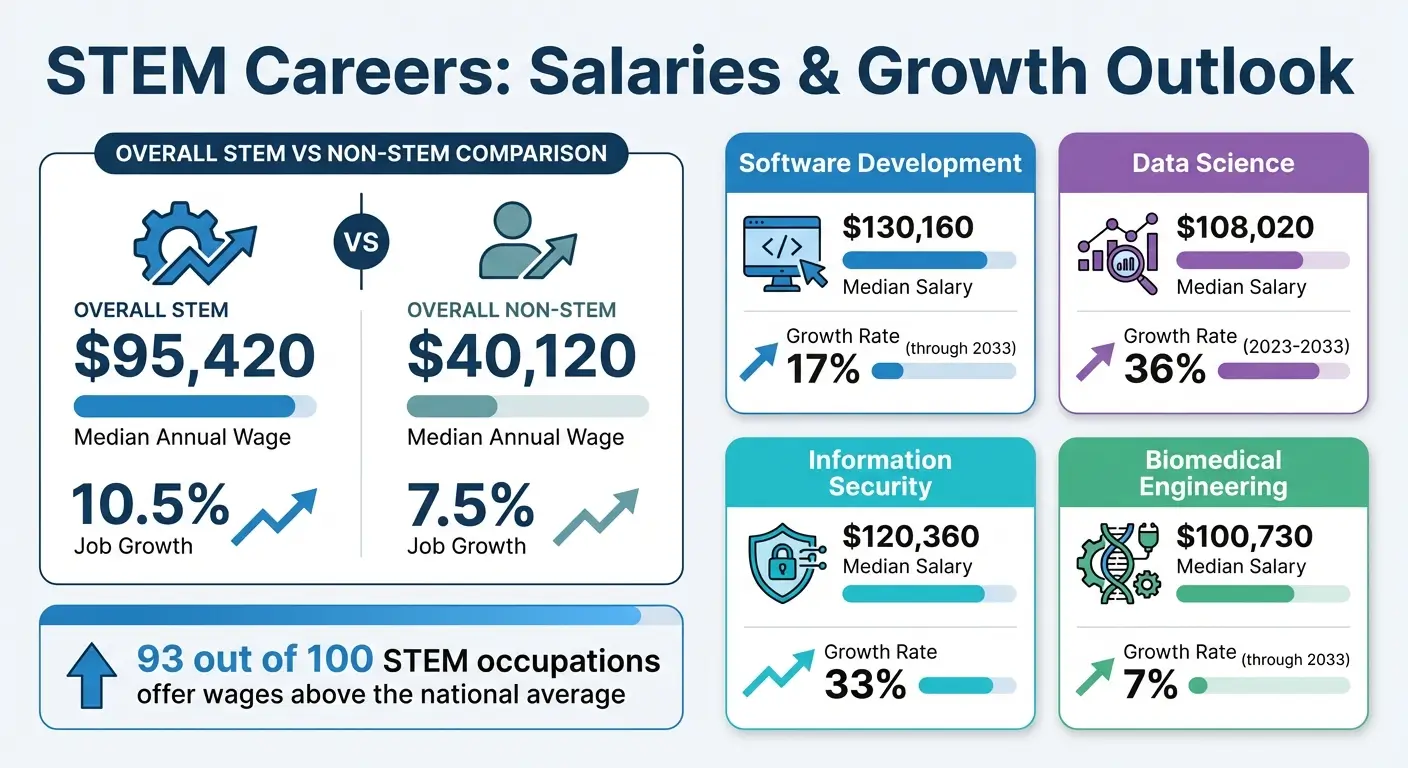
Homeschoolers have a unique advantage when it comes to pursuing STEM careers – they can shape their education to develop specialized skills early on. According to the U.S. Bureau of Labor Statistics, “STEM occupations are projected to grow faster than average over the next decade. Employers need skilled problem solvers who can keep up with advances in technology and science”. The data backs this up: in 2021, STEM careers had a median annual wage of $95,420, more than double the $40,120 median for non-STEM jobs. Job growth in STEM fields is also expected to hit 10.5%, compared to just 7.5% for non-STEM careers.
One of the perks of many STEM fields is that they rely heavily on skills rather than formal degrees. Homeschoolers can start building portfolios and earning certifications long before college. Here are three high-demand STEM paths that align particularly well with the flexibility of homeschooling.
Software Development and Programming
Software development is one of the most approachable STEM careers for homeschoolers. With a median salary of $130,160 and a projected growth rate of 17% through 2033, it’s not only financially rewarding but also in high demand. Employers in this field often prioritize a strong portfolio and proven skills over formal education.
Homeschoolers can begin with beginner-friendly programming languages like Python and JavaScript. Python is widely used in areas such as web development, data analysis, and automation, while JavaScript is essential for creating interactive websites. As students gain experience, they can specialize in areas like:
- Front-End Development: Focuses on the visual and user-facing aspects of websites.
- Back-End Development: Involves managing databases and server logic.
- Full-Stack Development: Combines both front-end and back-end expertise.
Hands-on practice is key. Building projects like personal websites, games, or calculators helps showcase technical skills. Homeschoolers can also strengthen their resumes by earning certifications from companies such as Google, Microsoft, and IBM.
Robotics and Engineering
For hands-on learners, robotics and engineering offer a perfect blend of creativity and technical expertise. These careers build directly on problem-solving and mathematical skills often nurtured in a homeschool setting. For instance, biomedical engineers – who design medical devices and diagnostic equipment – earn a median salary of $100,730, with a projected growth rate of 7% through 2033.
Robotics, in particular, encourages experimentation. Homeschoolers can start with beginner-friendly robotics kits and progress to more advanced projects, such as programming autonomous robots or designing mechanical systems. A solid math foundation is critical here, especially in algebra, geometry, and trigonometry, as these subjects form the backbone of most engineering and physics-related careers.
The rewards are significant: 93 out of 100 STEM occupations offer wages well above the national average.
Artificial Intelligence and Data Science
AI and data science are two of the fastest-growing fields in STEM, and they leverage the analytical and computational skills that many homeschoolers develop early. Data scientists earn a median salary of $108,020, with their field expected to grow by 36% from 2023 to 2033. Similarly, information security analysts, who protect digital systems from cyber threats, earn $120,360, with a growth rate of 33%.
Homeschoolers can dive into these fields through online courses and practical projects. Foundational knowledge in statistics, analytics, machine learning, and Python is essential. Tackling small projects, such as analyzing datasets, building recommendation systems, or creating basic machine learning models, can help students understand both the mechanics and reasoning behind algorithms.
What makes these fields especially exciting is their constant evolution. There’s always something new to learn, and homeschoolers who start early can build impressive portfolios that showcase not only their technical skills but also their ability to solve real-world challenges.
Building a STEM-Focused Homeschool Curriculum
Designing a STEM-focused homeschool curriculum doesn’t require an advanced degree or expensive equipment. Instead, it’s about combining foundational STEM skills with hands-on experiences that prepare students for future careers. By blending computer programming, robotics, engineering, and practical applications of math and science, you can create engaging projects tailored to your child’s interests. As James Brown, Executive Director of the STEM Education Coalition, puts it:
“The future of the economy is in STEM. That’s where the jobs of tomorrow will be”.
With over 60% of projected new STEM jobs tied to computer-related fields, teaching coding and computational thinking early is a practical way to set your child up for success.
To get started, align subjects with your child’s age and passions. Younger learners might enjoy block-based coding, while older students can transition to text-based languages like Python or Java. For example, if your child loves Minecraft, you can use modding to teach Java, or if Roblox is their preference, Lua programming can be introduced through game design. The 5E instructional model – Engage, Explore, Explain, Elaborate, and Evaluate – helps ensure learning is interactive and impactful. By weaving these elements into a cohesive curriculum, you’ll give your child the tools to explore STEM concepts through fun, meaningful projects.
Adding Coding and Programming
Programming is one of the easiest ways to dive into STEM, and homeschoolers can start building valuable skills and portfolios well before college. Platforms like CodaKid offer self-paced courses starting at $29 per month, teaching real programming languages through game-based projects. Students get hands-on experience with professional tools like Eclipse IDE and VS Code while developing games, apps, and mods – building both technical expertise and confidence.
Start with visual, block-based coding for younger learners, then transition to text-based languages as they grow. Tailor projects to your child’s interests. A student fascinated by artificial intelligence could explore Python, while one with a knack for web design might focus on JavaScript. CodaKid provides over 85 courses covering topics like AI, Python, JavaScript, Minecraft modding, and Roblox game development – all using professional-grade programming languages. Tackling these projects early builds a foundation for advanced software development and opens doors to future tech opportunities.
Hands-On Learning with Engineering and Robotics
Engineering and robotics bring abstract concepts to life, turning ideas into tangible creations. Tools like littleBits magnetic electronic blocks or Piper “build-your-own-computer” kits make circuitry and hardware accessible and fun. Robotics kits such as Arduino, Sphero, or CoDrone allow students to program robots and see their code in action.
A solid understanding of math – especially algebra, geometry, and trigonometry – is essential for engineering and robotics. You can integrate these subjects into building challenges. For instance, have your student calculate the load-bearing capacity of a structure they design or use trigonometry to program a robot’s navigation. These projects not only reinforce math concepts but also teach practical engineering skills. Competitions like FIRST Robotics or the Junior Solar Sprint add an exciting layer of real-world application and social interaction with other young innovators. These experiences develop critical problem-solving abilities that are key in engineering fields.
Teaching Math and Science Through Practical Applications
Math and science become much more engaging when linked to real-world scenarios. Everyday activities like cooking can bring scientific principles to life – explore temperature control while making caramel or use division, ratios, and unit conversions to scale a cookie recipe. Outdoor exploration can also spark curiosity; for example, observing plants and ecosystems introduces life science concepts.
Simple challenges, like testing how much weight a bundle of spaghetti noodles can support, combine engineering and math in a fun, hands-on way. This interdisciplinary approach connects science, technology, engineering, and math through problem-solving and real-world applications. The focus isn’t just on memorizing formulas but on fostering the analytical thinking skills that make STEM careers accessible. These practical experiences equip students to tackle complex challenges and prepare them for success in their future professional lives.
How CodaKid Supports Homeschoolers in STEM
Homeschooling families often look for flexible, high-quality resources that align with their unique schedules and learning preferences. CodaKid delivers just that with three tailored learning paths: self-paced courses, private one-on-one lessons, and virtual camps. Each option is designed to help homeschoolers build practical STEM skills that prepare them for future careers. These offerings expand on the project-based learning approach discussed earlier, making STEM education both engaging and accessible.
Self-Paced Courses for Independent Learners
For $29 per month, students gain access to a library of over 85 courses covering topics like AI, Python, JavaScript, Minecraft modding (using Java), and Roblox game development (using Lua). These courses use professional tools such as Eclipse IDE and VS Code to teach coding fundamentals, including Booleans, conditionals, variables, methods, loops, and functions. The project-based format lets students dive into fun, hands-on activities – like creating their own Minecraft mods or building Roblox games. To help learners overcome challenges, professional engineers provide live screen-share support and video tutorials.
One-on-One Lessons for Personalized Support
For students who thrive with direct guidance, CodaKid offers private one-on-one lessons at $249 per month. These sessions are led by a dedicated instructor who tailors the curriculum to the student’s interests, skill level, and goals. Families also receive regular progress updates, keeping parents in the loop. Plus, a friend or sibling can join the lessons at no extra cost, making it a budget-friendly option for families. These personalized lessons help students master professional programming languages like Python and even prepare for the Computer Science AP exam through Java-based Minecraft modding.
Virtual Camps for Group STEM Projects
CodaKid’s virtual camps are perfect for homeschoolers who enjoy working collaboratively. These one-week programs run for two hours daily during summer breaks, focusing on group projects in areas like AI, Roblox game creation, and advanced coding techniques. Students work together on exciting projects, building teamwork and communication skills that are essential in STEM fields. These camps combine the structure of project-based learning with the flexibility homeschooling families need, making them a great addition to summer schedules.
Preparing Homeschoolers for STEM Careers After High School
Stepping into college or the workforce from a homeschool background requires careful planning, especially for those aiming to thrive in STEM fields. Homeschoolers often excel in hands-on, project-based learning, which gives them an edge when showcasing real-world skills. STEM careers are a lucrative choice, offering a median annual salary of $55,000 – 66% higher than non-STEM roles – and growing at a rate of 7% per decade, compared to just 2% for other fields. With computer-related jobs making up over 60% of projected new STEM opportunities, homeschoolers who prepare strategically can tap into these high-demand careers.
Getting Certifications and Building Portfolios
In many STEM careers, a strong portfolio can outweigh formal certifications. For roles like software development, data science, and AI, employers often prioritize what candidates have built over their academic credentials. Homeschoolers can focus on creating tangible projects, such as functional websites, mobile apps, video games, or automation tools that solve real-world problems. Platforms like GitHub, which offers a Student Developer Pack with free professional tools, are excellent for hosting and showcasing these projects.
Certifications still hold value, particularly for college-bound students. For example, the Computer Science AP exam demonstrates Java proficiency and is widely recognized. For those heading straight into the workforce, free resources like freeCodeCamp offer certifications in areas such as responsive web design, JavaScript algorithms, and data visualization – each including practical projects to enhance portfolios. Students interested in specialized fields like AI, data science, or cybersecurity can explore certifications through online platforms and bootcamps.
Participating in high-stakes competitions is another way to stand out. Events like the Congressional App Challenge, which showcases winning apps in the U.S. Capitol, and FIRST Robotics, which offers access to over $50 million in scholarships, are excellent opportunities. The Regeneron Science Talent Search awards over $2 million in prizes, including a $250,000 top award for high school seniors. These competitions highlight qualities like dedication, initiative, and leadership – traits that resonate with college admissions officers and employers alike. Beyond validating skills, these experiences help homeschoolers transition smoothly into higher education or tech careers.
Planning for College and Career Options
With a solid portfolio and relevant certifications in hand, homeschoolers can focus on mapping out their college and career paths. For those pursuing higher education, emphasizing advanced math and science coursework – such as Calculus, Physics, Chemistry, and Biology – is crucial. These subjects demonstrate the academic rigor admissions offices look for. Homeschoolers should also take the PSAT/NMSQT to qualify for the National Merit Scholarship Program and use the homeschool-specific code 970000 when registering for the SAT. Even dedicating six to eight hours to Official SAT Practice can boost scores by an average of 90 points.
For students planning to enter the workforce directly, Career and Technical Education (CTE) courses and bootcamps provide targeted certifications in areas like Information Technology, Manufacturing, and Software Development. While 2021 data shows that 89.3% of STEM workers with a bachelor’s degree were employed, many tech roles now prioritize practical skills over formal degrees. Building a portfolio through project-based learning – such as mastering professional programming languages and tools – can make homeschoolers highly competitive in the job market.
Additionally, gaining external validation through internships, summer research programs at local labs or tech companies, and letters of recommendation from mentors can further strengthen their resumes. These experiences not only showcase technical abilities but also help homeschoolers build valuable professional networks.
Conclusion
Homeschooling gives families the chance to focus on hands-on STEM learning, helping kids develop practical technical skills and resilience. With computer-related fields making up over 60% of projected new STEM jobs, students who study computer science can earn, on average, 8% more by the time they’re 26.
Starting young is key. Kids as young as five can dive into STEM concepts through visual coding platforms, which act as a stepping stone to more advanced programming languages like Python and Java. Tapping into your child’s interests – whether it’s Minecraft modding, Roblox game creation, or experimenting with AI – can make coding an exciting adventure. As David Dodge, CEO of CodaKid, puts it:
“Make. Coding. Fun.”
CodaKid offers self-paced courses, personalized lessons, and virtual camps to guide learners from beginner to advanced.
With 90% of parents and 75% of professionals valuing coding, adding STEM to your homeschool curriculum has never been more relevant. Plus, with 65% of today’s kids likely to work in jobs that don’t even exist yet, a STEM-rich education prepares them to thrive in a tech-focused future. Weaving coding, engineering, and hands-on science into homeschooling doesn’t just teach kids to code—it nurtures tomorrow’s innovators.
FAQs
How can homeschoolers create a strong portfolio for STEM careers?
To create a standout STEM portfolio, homeschoolers should clearly present their skills, projects, and accomplishments. Start with a personal statement that reflects their enthusiasm for STEM fields. Include relevant coursework, certifications, awards, and extracurricular activities like robotics clubs or science fairs. The heart of the portfolio should be project entries – explain the problem tackled, the tools used (like Python, AI, or Arduino), and the outcomes. Including visuals, such as screenshots or videos, can help bring these projects to life.
Homeschoolers can take their portfolios to the next level by working on practical coding or AI projects through structured platforms like CodaKid, which offers self-paced courses in Python, JavaScript, Minecraft modding, and more. Students produce tangible results—like a custom game mod or basic AI model—ready to showcase in their portfolio. Complement these projects with hands-on STEM activities like robotics or experiments, and organize everything in a polished digital format. This approach not only highlights their skills but also demonstrates their commitment to STEM learning.
What are some budget-friendly options for teaching coding at home?
Teaching coding at home doesn’t have to break the bank. There are plenty of free and budget-friendly resources available to help homeschoolers pick up programming skills. For example, Code.org provides free activities for students from kindergarten through 12th grade. These activities include fun, game-based projects that teach coding basics and even touch on AI concepts. Parents can also introduce their kids to real-world programming tools like Visual Studio Code or Replit, both of which are free and compatible with most computers. These tools offer hands-on experience in actual coding environments.
For younger children, Scratch 3.0 is a fantastic free platform. It makes learning to code fun and accessible by allowing kids to create interactive games and stories. If you’re looking for a more structured option, CodaKid offers affordable, self-paced courses in Python, JavaScript, Minecraft modding, and more. They even provide optional one-on-one tutoring to keep lessons engaging and tailored to each child’s needs. These resources make teaching coding at home affordable and a smart way to prepare kids for STEM opportunities.
What are the benefits of STEM competitions for homeschoolers?
STEM competitions provide homeschoolers with a fantastic chance to highlight their talents, gain recognition, and even win scholarships or prizes. They also help students build a standout portfolio for college applications and unlock future career opportunities.
But the benefits go far beyond the tangible rewards. Participating in STEM competitions helps students develop critical skills like problem-solving, teamwork, and creative thinking. Many competitions present real-world challenges, giving students the chance to collaborate with mentors and apply technical knowledge in hands-on ways. These experiences not only sharpen their STEM abilities but also build confidence in managing complex projects.
To get ready for these competitions, many families turn to resources like CodaKid. This platform offers game-based coding and AI courses that teach real programming languages and tools. These skills are essential for tackling areas like robotics, app development, and other STEM-related challenges.