AI education for kids and teens is shifting from using AI tools like ChatGPT to teaching them how to create AI-powered applications. The best AI classes like CodaKid focus on hands-on projects, helping students build games, chatbots, and apps using tools like Python, TensorFlow, and APIs. This approach develops coding skills and problem-solving abilities, preparing students for future tech challenges.
Key Options (Best AI Classes):
- Self-Paced Courses ($29/month): Over 800 hours of projects, from beginner to intermediate, covering AI game design, web apps, and more.
- Private 1:1 Lessons ($249/month): Weekly personalized sessions with expert instructors for faster progress.
- Virtual Camps (~$447.99/program): One-week intensive programs with live instruction, focusing on building portfolio-ready AI projects.
Each format offers live support and guidance from skilled instructors, ensuring students can work through challenges effectively. Whether your child is a beginner or an advanced learner, these programs provide a structured way to move beyond prompts and start creating functional AI applications.
Table of Contents
1. CodaKid Self-Paced Courses
Project-Based Learning
CodaKid’s self-paced program offers over 800 hours of hands-on AI projects across 85+ courses. Students get the chance to create functional applications using tools like Gemini API, Python, and JavaScript. The curriculum is divided into three main areas: AI Foundations, Web & App Creation with AI, and AI-Driven Game Design.
For beginners, projects include creating an AI-powered Rock Paper Scissors game or an AI Cartoon Creator, while intermediate learners tackle more advanced challenges, such as developing an AI RPG Adventure or integrating AI as a “code partner” in projects like AI Space Attack. Every project focuses on teaching students how to incorporate cutting-edge Large Language Models into real-world applications.
This curriculum blends creativity with professional-grade tools, making it accessible and practical for learners at all levels.
Pricing and Accessibility
The self-paced subscription is available for $29 per month, granting unlimited access to the entire course library. New students can also take advantage of a 14-day free trial. Families with multiple learners can choose the Family Plan for $45 per month, which supports up to three student accounts and includes a parent dashboard. For those who prefer an annual subscription, the cost averages out to about $23 per month when billed yearly.
Instructor Support
CodaKid ensures students have access to live support from professional software developers via in-platform chat or email. Additionally, there are weekly Drop-In Coaching sessions every Friday afternoon to provide real-time guidance. Parent Christy Lynn shared her experience:
“The response to help requests is always immediate and they do a great job finding and explaining the issues he may be having”.
This combination of live support and flexible, 24/7 learning ensures students can move forward without hitting roadblocks, making it easier to stay on track while learning at their own pace.
2. CodaKid Private Lessons 1:1
Project-Based Learning
CodaKid’s 1:1 lessons take the foundation of their self-paced projects and add a personal touch, offering tailored guidance to speed up learning. These private lessons adapt to each student’s pace and interests, covering programming languages like Python and JavaScript while diving into advanced tools like large language models. The goal? To create impressive projects such as AI-powered games, personal websites, and custom web-based video games – all designed to showcase students’ skills.
The teaching approach, called the “Mastery Method”, follows a Socratic style that encourages students to solve problems independently instead of relying on direct answers. This technique sharpens critical thinking and debugging skills while introducing concepts like “vibe coding”, where students learn to collaborate with AI as a coding partner in real-world development scenarios. Weekly 50-minute sessions build progressively on previous lessons, with homework reinforcing the learning process.
Pricing and Accessibility
The standard plan for private 1:1 lessons is $249 per month, covering four weekly sessions. For those looking to accelerate their progress, the Accelerated 1:1 plan offers eight sessions per month at $450. New students can take advantage of a free first session to try it out. Billing is month-to-month, giving families the freedom to cancel before the next billing cycle if needed.
This pricing structure is paired with attentive, expert support during each session.
Instructor Support
CodaKid’s instructors are handpicked from top U.S. universities, ensuring a high level of expertise. After every session, parents receive detailed progress reports highlighting achievements and areas for improvement. Students also benefit from prioritized technical support outside of class and have access to Friday afternoon Drop-In Coaching sessions for extra help.
Here’s what Jo Warn, a grandparent, had to say about her experience:
“Ethan has an incredible way of communicating and interacting with Jonathan which makes every coding class so beneficial and an exciting part of Jonathan’s education. What great instructors CodaKid choose”.
To ensure the best match, CodaKid offers a 100% instructor match guarantee, aligning teaching styles with each student’s unique learning needs.
Learn to code your own Smash Bros game with Python!
3. CodaKid Virtual Camps
CodaKid Virtual Camps provide an immersive, hands-on coding experience, focusing on creating practical projects that students can be proud of.
Project-Based Learning
These one-week intensive programs include two hours of live instruction daily. Students dive right into building real-world applications using tools like Python, JavaScript, Java, and top Large Language Models. A standout feature is their “vibe coding” approach, which teaches students how to collaborate with AI as a coding partner to develop functional systems and applications.
The camps cater to all skill levels. Beginners start with coding basics, while more experienced students learn about APIs and AI debugging. The curriculum revolves around engaging projects: younger students (ages 5+) explore arts and game development, while older participants (13+) work on creating AI systems and applications using professional-grade APIs.
Pricing and Accessibility
CodaKid Virtual Camps come with a money-back guarantee, offering families peace of mind when trying the program. All instructors are based in the U.S., and classes are available in every U.S. time zone, making it easy for families to find convenient schedules. For technical issues, students can access immediate support through live chat and screen-sharing.
Instructor Support
Instructors, recruited from top U.S. universities, use the Mastery Method to guide students effectively. Support is available throughout the week.
Parent Ci Tro shared their experience:
“A huge plus for busy parents is the outstanding and swift support from CodaKid. No frustrating long deadlock, but friendly, competent help to keep the kids going and exploring”.
This camp model emphasizes transforming students from passive users of AI into active creators, staying true to the program’s project-centered philosophy.
Pros and Cons
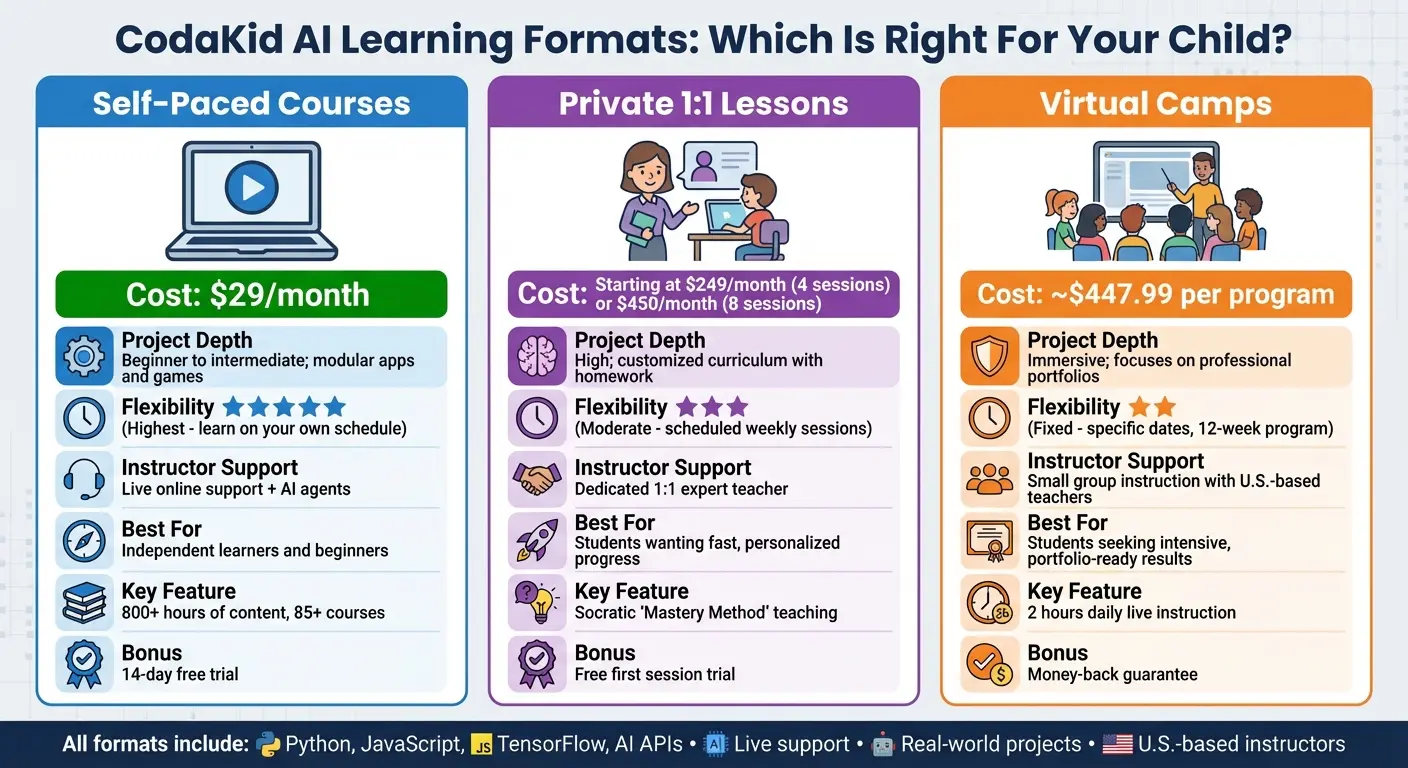
CodaKid AI Learning Formats Comparison: Self-Paced vs 1:1 Lessons vs Virtual Camps
CodaKid offers multiple learning formats, each tailored to different needs, schedules, and goals. Here’s how they compare across key factors:
| Feature | Self-Paced Courses | Private 1:1 Lessons | Virtual Camps / AI Academy |
|---|---|---|---|
| Project Depth | Beginner to intermediate; modular apps and games | High; customized curriculum with homework | Immersive; focuses on professional portfolios |
| Cost | $29/month | Starting at $249/month | ~$447.99 per program (12-week academy) |
| Flexibility | Highest; learn on your own schedule | Moderate; scheduled weekly sessions | Fixed; specific dates (e.g., 12-week program) |
| Instructor Support | Live online support + AI agents | Dedicated 1:1 expert teacher | Small group instruction with U.S.-based teachers |
| Best For | Independent learners and beginners | Students wanting fast, personalized progress | Students seeking intensive, portfolio-ready results |
Strengths and Challenges
Each format has its strengths and challenges, depending on what works best for the learner.
Self-paced courses are a budget-friendly option that offers maximum flexibility. Learners can explore a variety of topics at their own pace with support from live help desk staff and AI agents familiar with the curriculum. However, these courses lack a dedicated instructor to monitor progress, which might not suit students who need more structure.
Private 1:1 lessons provide a highly personalized experience. Students benefit from focused, one-on-one instruction, tailored homework assignments, and access to unlimited help desk support. This format is perfect for those who thrive with individualized attention and accountability.
Virtual camps deliver an immersive and intensive learning environment. These programs focus on creating portfolio-ready projects, such as personal websites or custom video games, within a structured schedule. While the fixed dates might limit flexibility, the hands-on approach is ideal for students seeking in-depth, professional-level results.
CodaKid’s variety of learning formats ensures that students can turn their ideas into real, creative projects. Whether your child is exploring coding for the first time or aiming to build a polished portfolio, there’s an option to suit their needs.
Conclusion
The best AI classes for kids and teens in 2026 emphasize creating real-world applications using professional tools. CodaKid offers three distinct learning formats tailored to different needs: flexible self-paced courses, personalized 1:1 lessons, and immersive Virtual Camps. By focusing on hands-on projects, these programs equip students with the skills they’ll need to tackle tomorrow’s tech challenges.
Through project-based learning, students dive into “vibe coding”, where they collaborate with AI to design functional applications. This method nurtures systems thinking and broad engineering skills – key abilities for the future workforce.
CodaKid has a proven track record of turning curious beginners into capable developers. Whether your child is just starting with AI or building a portfolio for college, the focus on practical projects ensures they’re gaining skills that will remain relevant well into the future.
FAQs
What age range is ideal for CodaKid’s AI classes?
CodaKid offers AI classes designed specifically for kids and teens, starting as young as 8 years old and extending through high school. Most courses cater to learners aged 8 and up, with some intermediate options better suited for those 9 and older. These programs are thoughtfully crafted to deliver engaging, age-appropriate lessons for students between 8 and 18 years old, equipping them with practical AI skills as they progress through their education.
What’s the difference between CodaKid’s self-paced courses and virtual camps?
CodaKid offers two distinct learning options: self-paced courses and virtual camps, catering to different learning styles and schedules.
With self-paced courses, students gain unlimited, on-demand access to a library featuring over 85 courses. Topics include AI, Python, Scratch, Minecraft, Roblox, and more. Learners can start whenever they want, move through the material at their own speed, and keep access to the content as long as they remain enrolled. This approach is perfect for those who prefer flexibility and working independently.
On the other hand, virtual camps provide a live, instructor-led experience. These camps run for one week, with two-hour sessions held daily, focusing on specific themes like AI, Roblox, or Python. The structured format and interactive group setting make these camps a great fit for kids and teens who enjoy learning in a collaborative, guided environment.
While self-paced courses offer a wide range of topics and flexible scheduling, virtual camps provide an engaging, hands-on learning experience in a condensed, immersive format.
What types of projects will kids and teens create in CodaKid’s AI classes?
In CodaKid’s AI classes, students get to work on engaging, hands-on projects that stretch far beyond basic AI prompts. Imagine creating interactive games like a Rock-Paper-Scissors AI Edition, an AI-powered RPG adventure, or even a space-shooter game that adjusts to how you play. For those with a creative streak, there are projects like building an AI Cartoon Creator, crafting quirky AI-generated fun facts, or designing a multilingual assistant for language learning.
As they progress, students take on more advanced challenges, such as building AI-powered websites or custom web-based games. They also gain experience with AI tools for tasks like coding assistance, debugging, and content creation. By the time they complete the program, they’ll have a standout portfolio that highlights their technical skills and imaginative projects.