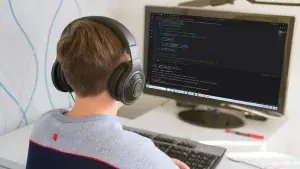
Python is an ideal programming language for kids due to its simple syntax and versatility. Whether your child is just starting or ready for advanced projects, Python offers opportunities to learn coding while building practical skills. Here’s a quick guide to the best Python courses for kids in 2026, tailored by age and goals:
- Ages 8-12: CodaKid Self-Paced Courses focus on beginner fundamentals through game-based projects. Kids learn variables, loops, and functions while creating games like “Fish Eat Fish.” Costs start at $29/month with a 14-day free trial.
- Ages 13-17: CodaKid Private Lessons provide one-on-one guidance for teens interested in game development. Students tackle advanced techniques like inheritance and vectors. Pricing begins at $249/month for four sessions.
- Ages 10-15: CodaKid Virtual Camps introduce AI concepts like generative AI and prompt engineering. These one-week camps include hands-on projects such as AI-powered web apps. Costs vary, with referral discounts available.
Each option offers live support, access to professional tools, and project-based learning to keep kids engaged. Whether your child wants to create games, explore AI, or master coding basics, these courses provide structured paths to learn programming effectively.
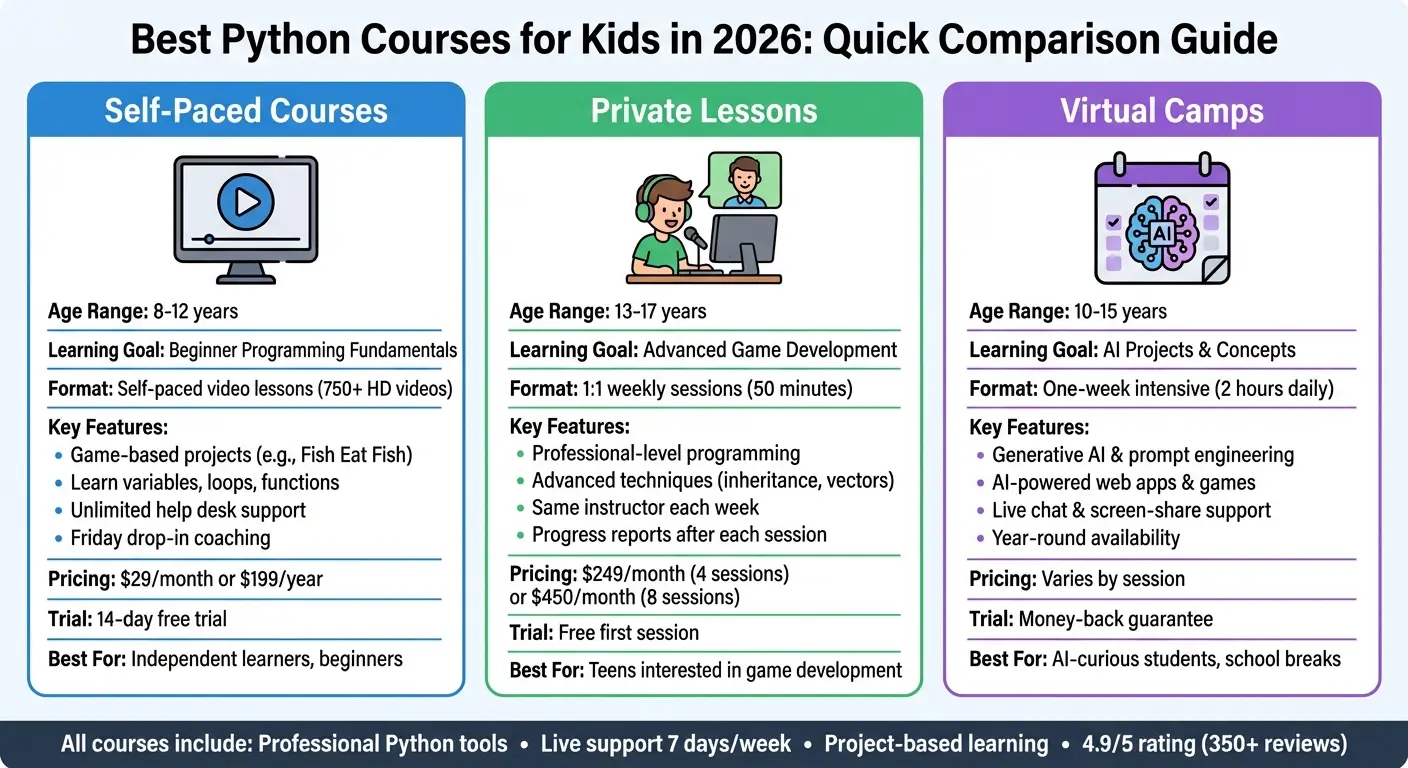
Best Python Courses for Kids 2026: Age-Based Comparison Guide
Table of Contents
1. CodaKid Self-Paced Courses for Ages 8-12 Beginners
Age Suitability
CodaKid’s self-paced Python courses are tailored for kids aged 8 and up, making them ideal for elementary and middle school students. The Python 1 – Explorer track is perfect for beginners starting at age 8, while more advanced options like Python 2 – Trooper (recommended for ages 9+) and Python 3 – Captain (geared toward ages 10+) offer a natural progression as students gain confidence and skills. This thoughtful structure ensures younger learners start with manageable challenges while leaving plenty of room for growth through increasingly complex lessons.
Learning Goal
These courses focus on teaching beginner programming fundamentals through fun, game-based projects. Students create their own games, like “Fish Eat Fish”, and other interactive apps using text-based Python programming, reflecting real-world industry practices. Along the way, kids learn essential concepts such as variables, loops, and functions. The curriculum emphasizes hands-on learning through a “watch, pause, code, design, and test” approach, which encourages students to actively apply what they learn rather than passively watching tutorials.
Course Format
The self-paced format gives kids the flexibility to learn at their own speed. With access to over 750 HD video lessons covering a variety of projects, students can dive into coding on their schedule. For those moments when they hit a roadblock, CodaKid offers unlimited help desk support via chat or email, as well as live drop-in coaching sessions every Friday afternoon. Parents have praised the quick and effective support, which helps keep kids motivated and on track. The subscription also unlocks access to CodaKid’s entire library, including courses on Scratch, JavaScript, and more, allowing kids to explore beyond Python if they wish.
Pricing and Affordability
CodaKid’s subscription is priced at $29 per month for a single student, with an annual option available for $199 (about $17 per month). Families with multiple children can choose the Family Plan for $45 per month or $270 per year. New users can take advantage of a 14-day free trial, offering unlimited access to explore the platform before making a commitment. With its award-winning reputation and a price point far lower than private tutoring, CodaKid delivers excellent value for families looking to introduce their kids to coding.
2. CodaKid Private Lessons for Ages 13-17 Game Development
Age Suitability
CodaKid’s private lessons are tailored for teens aged 13-17 who are ready to dive into professional-level programming. Unlike self-paced courses for beginners, these lessons use the “Python 3 – Captain” track, where students create multiplayer games and server-side applications. Along the way, they learn advanced techniques like inheritance, vectors, and arrays – skills that go beyond basic coding and mirror what professional developers use in real-world projects. This curriculum is designed to challenge and prepare students for more complex, high-level programming tasks.
Learning Goal
The private lessons aim to equip students with advanced game development skills using professional tools and real Python code. Projects are built on industry-standard frameworks, encouraging students to think critically and solve problems creatively. CodaKid’s Mastery Method™ takes a Socratic approach, focusing on architectural thinking and problem-solving instead of memorization [12, 13]. Instructors, who are experts in both programming and teaching, guide students in developing a mindset that mirrors how professional developers think and work.
Course Format
These private lessons are conducted in a 1:1 format, offering personalized guidance from instructors who hail from top U.S. universities. Each weekly session lasts 50 minutes and is taught by the same instructor, ensuring consistency and a personalized learning experience tailored to the student’s pace and style. After every session, students receive detailed progress reports. They also have access to prioritized technical support outside of class, including Drop-In Coaching sessions held on Friday afternoons.
Pricing and Affordability
CodaKid’s private lessons are available at $249 per month for four 50-minute sessions (one session per week) or $450 per month for eight sessions. A free trial session is offered for those who want to explore the program before committing. Additionally, CodaKid offers a 2-on-1 sibling special, allowing a sibling or friend to join the private class at no extra cost [12, 13]. With a stellar 4.9/5 rating from over 350 reviews and recognition as an ESA provider, these lessons combine high-quality instruction with excellent value.
3. CodaKid Virtual Camps for Ages 10-15 AI Projects
Age Suitability
CodaKid’s virtual camps are designed for students aged 10–15, offering projects that cater to both beginners and those with some coding experience. The curriculum includes accessible options like the “Fun Fact Generator” for newcomers and more advanced challenges like “AI Space Attack” for intermediate learners. For students new to text-based coding, CodaKid recommends starting with beginner Python courses to build a strong foundation before tackling intermediate AI projects.
Learning Goal
These camps aim to build on basic Python skills while introducing students to key AI concepts. The curriculum covers generative AI, large language models, prompt engineering, and AI ethics – topics that reflect the latest trends in the tech world. Using tools like Python and the Gemini API, students create practical AI applications, such as AI-powered web apps, custom AI-generated videos, and games. The hands-on, project-based approach encourages critical thinking and problem-solving, with students completing projects they can proudly showcase.
Course Format
To meet these learning goals, the camps follow an intensive, immersive format. Each virtual camp runs for one week, with daily two-hour sessions. Students connect online with instructors from top-tier U.S. universities, ensuring high-quality guidance. The program combines live teaching with hands-on project work, and students can access live chat and screen-share support to resolve technical issues during their sessions. CodaKid offers these camps year-round, scheduling sessions during summer and school breaks for added flexibility.
Pricing and Affordability
The cost of enrollment varies by session, but CodaKid provides options to make the camps more affordable. They offer a money-back guarantee and a “Give $100 – Get $100” referral program to help reduce costs. With over 350 reviews and an impressive 4.9 out of 5 rating, along with recognition like the Parents’ Choice Gold Award, these camps provide a great opportunity for families looking to introduce their kids to AI programming.
Why CodaKid Works Well for Python Learning in 2026
CodaKid stands out because it teaches kids to code using real programming languages and professional tools – the same ones used by companies like Google, Facebook, and Intel. Instead of relying on simplified coding platforms, students dive into actual Python programming, gaining skills that can be applied to real-world careers in fields like software development, web design, and data science. This focus on industry-standard tools creates a strong foundation for practical, project-based learning.
The project-based curriculum keeps students engaged by allowing them to create games and apps they’re excited about. With over 800 hours of projects and 750+ instructional videos, CodaKid emphasizes hands-on experience. Its Mastery Method™ goes beyond teaching syntax, helping students grasp the deeper logic behind coding. This approach equips kids with the critical thinking skills they’ll need for solving complex problems in the future.
CodaKid also offers flexible learning formats to suit different preferences, including self-paced courses, one-on-one lessons, and intensive camps. No matter the format, students have access to live support seven days a week, with chat and screen-sharing options to resolve technical challenges quickly.
“A huge plus for busy parents is the outstanding and swift support from CodaKid. No frustrating long deadlock, but friendly, competent help to keep the kids going and exploring.” – Ci Tro, Parent
With glowing reviews and international recognition, CodaKid provides a clear path for students to progress from beginner-friendly projects to more advanced challenges. Along the way, they earn certificates and badges, making their achievements both measurable and rewarding.
Conclusion
When choosing a Python course for your child, it’s important to consider their age, interests, and goals. For younger kids aged 8-12 who enjoy working independently, CodaKid offers self-paced courses that let them learn at their own speed. Teens aged 13-17 with a passion for game development can benefit from private one-on-one lessons with personalized mentorship. Kids aged 10-15 curious about AI can join one-week virtual camps focused on real-world AI projects and applications.
What sets CodaKid apart is its use of professional tools – the same Python environments used by major tech companies. Whether your child dreams of creating multiplayer games, developing AI-powered apps, or mastering the basics of coding, these courses equip them with skills that can lead to future careers in software development and data science.
CodaKid’s success speaks for itself. With 100,000+ students in 120+ countries and a 4.9/5 rating from 350+ reviews, CodaKid grows with your child’s learning needs. Its flexibility lets families start with self-paced courses, then transition to private lessons or camps as interests and goals evolve.
Think about what excites your child. If they love gaming, courses that teach Python through game creation are a great fit. If they’re fascinated by AI, virtual camps offer hands-on experience with cutting-edge technology. Matching their interests with the right course format keeps them engaged and eager to learn.
Plus, CodaKid provides 7-day live support to ensure technical challenges don’t hinder progress. With a 14-day free trial for self-paced courses and free first private lesson, explore your options before committing. A great Python course ignites a passion for learning and builds future-ready skills, going far beyond just teaching syntax.
FAQs
Why is Python a great programming language for kids to learn?
Python is a great programming language for kids because its syntax is simple and easy to understand. It feels a lot like everyday English, which means young learners can focus on grasping coding concepts without getting bogged down by confusing symbols or tricky punctuation. The way Python uses indentation and straightforward commands like print and if makes it especially beginner-friendly.
One of the best parts? Kids can see the results of their code almost immediately. Whether they’re designing a game, creating animations, or crafting interactive stories, Python provides instant feedback. This not only keeps things fun but also helps maintain their interest. Python isn’t just for learning—it powers YouTube, Instagram, and cutting-edge AI projects, showing kids real-world applications of their skills. This shows kids how they can apply their new skills in the real world.
Beyond coding, learning Python helps kids develop essential skills like problem-solving, logical thinking, and creativity. Starting with Python builds confidence and a strong foundation, paving the way for exploring more advanced programming languages later.
How does CodaKid cater to different learning styles and speeds?
CodaKid offers learning options designed to match different learning styles and speeds. Kids can choose self-paced video courses with HD lessons to pause, rewind, and experiment with code at their own pace. This approach works well for visual and hands-on learners who enjoy working independently.
For kids who thrive with direct support, CodaKid also offers 1:1 private tutoring. These sessions are led by U.S.-based instructors who customize lessons to fit each child’s pace and unique learning style.
Both learning paths incorporate professional tools like Python, Minecraft, and Roblox, enabling kids to create fun projects while deepening their understanding of coding concepts. Whether learning by watching, doing, or mentoring, CodaKid lets kids build skills confidently at their own comfort level.
What can kids learn from CodaKid’s Python courses?
CodaKid’s Python courses are designed to teach kids essential coding skills through engaging, hands-on projects. Students learn Python by creating games, apps, websites, and drone programs using professional developer tools.
As kids design, code, test, and debug their projects, they sharpen their problem-solving and computational-thinking abilities. The curriculum introduces advanced topics like data structures, algorithms, and AI projects, building confidence to tackle increasingly complex challenges. Along the way, they learn project planning and collaborative coding, building foundations for future success in tech academics and careers.