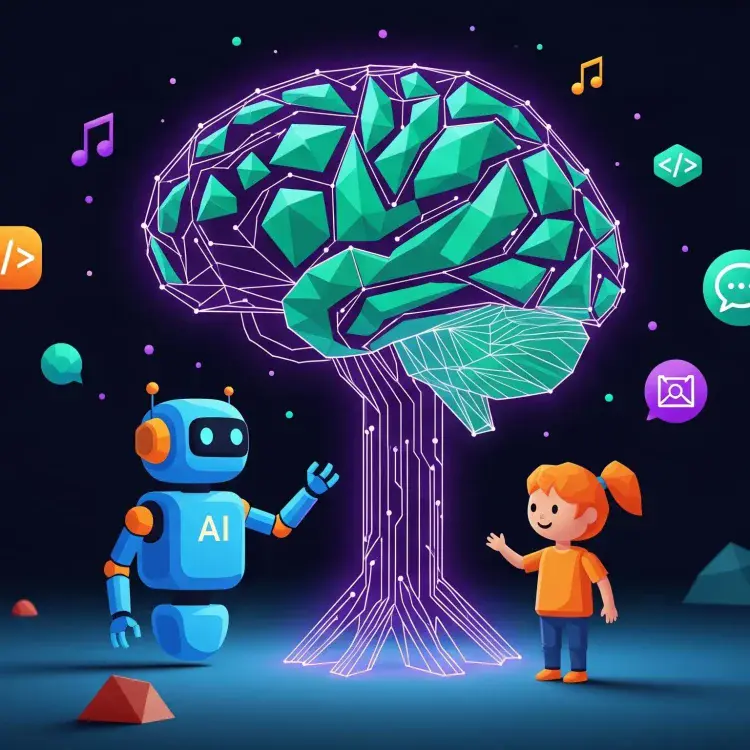
Humans and AI think and learn differently, and understanding these differences (AI vs. Human Intelligence) is key to using technology wisely. Here’s the gist:
- AI: Works by analyzing large amounts of data to find patterns. It powers tools like Netflix recommendations, Siri, and Google Maps. AI is fast, precise, and great at repetitive tasks but struggles with creativity and emotions.
- Humans: Use emotions, imagination, and intuition to solve problems, learn from a few experiences, and connect with others. Humans excel at understanding feelings, adapting to new situations, and thinking beyond patterns.
- Why learn about AI? Kids interact with AI daily through apps and games. Learning how it works prepares them for future careers, helps them make smart tech choices, and highlights the importance of human qualities like empathy and creativity.
Bottom line (AI vs. Human Intelligence): AI and humans are better together. AI handles data and speed, while humans bring emotions and originality to the table. Teaching kids about AI helps them thrive in a tech-driven world.
New to AI? Start with our beginner’s guide to AI for kids.
Table of Contents
Inside CodaKid: The AI & Coding Course Every Parent Should Know About
How AI Thinks vs. How Humans Think (AI vs. Human Intelligence)
AI processes information in a way that’s fundamentally different from how your brain works. By understanding these differences, it becomes clearer why AI excels at some tasks while humans shine in others. Let’s dive into how each approaches learning and decision-making.
AI Learns From Data
AI relies on huge amounts of data to learn. It identifies patterns by analyzing thousands – or even millions – of examples to determine the “most likely best fit” answers to problems. Essentially, AI stores vast amounts of information and uses statistical methods to uncover connections.
For example, when AI learns to detect spam emails, it doesn’t actually understand what spam is. Instead, it studies millions of emails labeled as “spam” or “not spam” by humans. By identifying patterns in the words, sender addresses, and formatting, it predicts which emails are likely spam.
This method makes AI incredibly fast at processing large datasets. However, it also means AI can only work with patterns it has encountered before. If something entirely new comes along, AI might struggle to adapt.
Humans Use Ideas and Feelings
Your brain, on the other hand, combines logic, emotions, and imagination to create a deeper understanding of the world. Unlike AI, you don’t need thousands of examples to grasp a new concept – you can often learn from just one or two experiences.
Emotions play a key role in how humans learn and make decisions. Pain, joy, fear, and excitement are powerful teachers that help you retain important lessons. For instance, touching a hot stove just once is enough to teach you to avoid it in the future. This emotional learning creates lasting memories that guide your behavior.
Additionally, your brain benefits from evolutionary “pre-training” encoded in your DNA. This natural advantage gives you instinctual knowledge and a foundational understanding that AI simply doesn’t have. It allows you to navigate complex social situations, grasp abstract ideas, and make unexpected creative leaps.
Another unique human trait is emotional intelligence – the ability to recognize, understand, and respond to emotions, both your own and others’. This skill shapes your decisions and helps you form meaningful relationships, something AI cannot replicate.
Example: Learning to Recognize Animals
The difference between AI vs. human intelligence becomes strikingly clear when comparing how each learns to identify animals. AI depends on countless examples to learn that a golden retriever is a dog. It analyzes pixel patterns, shapes, colors, and textures across numerous images to build a model of what defines a “dog.”
However, AI might falter if it encounters a breed it hasn’t seen before or if the image is taken from an odd angle or in poor lighting.
You, on the other hand, can learn to recognize dogs after seeing just a few examples. Your brain connects new information to existing knowledge, emotions, and experiences. You understand that dogs can vary in size, color, and shape, but they share common traits like having four legs, tails, and often friendly behavior.
More importantly, you grasp the concept of what a dog is – a living creature with feelings, needs, and a personality. You can even predict how a dog might behave in unfamiliar scenarios, thanks to your ability to think conceptually and creatively. This kind of understanding highlights a core difference between human intelligence and artificial intelligence.
What Makes Humans Special?
AI might process data at lightning speed, but human intelligence stands out in areas like creativity, empathy, and the ability to adapt. Our brains possess unique capabilities that even the most advanced AI systems can’t replicate.
Ideas and Imagination
Humans have the remarkable ability to dream up entirely new ideas. You can imagine things that don’t exist – like a flying elephant or a story about robots befriending dinosaurs. This kind of thinking is something AI simply can’t do on its own.
AI works by analyzing patterns from the data it has been trained on. It can combine existing elements in novel ways, but it doesn’t truly imagine or generate original ideas the way people do. That’s why human creativity shines in art, music, and storytelling – it’s fueled by genuine imagination and emotion, making it deeply meaningful.
Imagination also plays a big role in problem-solving. For instance, you might see a cardboard box as a spaceship, a fort, or even a robot costume. This ability to think outside the box allows humans to come up with solutions that go beyond AI’s rigid, pattern-based methods.
This creative spark is complemented by our ability to understand and respond to emotions, which shapes human connections and insights.
Understanding Feelings and Situations
Humans are experts at picking up on subtle cues and understanding the deeper meaning behind words and actions. For example, if your friend sarcastically says, “Nice job”, after you accidentally spill juice on their homework, you immediately sense their frustration. You don’t just hear the words – you interpret the tone and context.
This skill goes beyond words. You can notice when someone is upset even if they’re trying to hide it or know when humor might lighten the mood. These social and emotional skills help us navigate complex relationships and communicate in ways AI simply can’t replicate.
Understanding emotions and situations also helps humans adjust quickly to new environments.
Changing to New Situations (AI vs. Human Intelligence)
Humans are incredibly quick to adapt to new circumstances without needing extensive preparation. Research from Harvard Business School highlights just how extraordinary this ability is.
In experiments involving video games designed to test adaptability, humans consistently outperformed AI. The reason? Humans possess “self-orientation” – an awareness of who we are and how we fit into a situation.
“Our research shows that a key ingredient that makes us flexible is having a notion of the ‘self,’ and we concretely show what this buys humans over AI”, explains Julian De Freitas, Assistant Professor at Harvard Business School.
Think about walking into a new classroom, starting a new sport, or visiting a friend’s house for the first time. Your brain quickly figures out the rules, expectations, and social dynamics without needing detailed instructions. AI, on the other hand, requires extensive programming and training for each new scenario.
“People were solving everything faster; self-orientation doesn’t seem to exist at all for AI”, notes De Freitas.
Humans also excel at shifting attention. If you’re doing homework and suddenly hear your dog barking in an unusual way, you can immediately stop and investigate. AI systems, however, tend to have task-specific focus and lack the ability to dynamically redirect attention based on changing priorities or unexpected events.
This adaptability is a cornerstone of what makes humans so exceptional at overcoming challenges.
What Are AI’s Strong Points (vs. Human Intelligence)?
While humans excel in creativity and empathy, AI brings unmatched computational power and consistency to the table. Its strengths lie in speed, precision, and the ability to detect patterns – qualities that complement human ingenuity.
Speed and Accuracy
AI processes information and performs calculations at speeds that feel almost superhuman. For instance, while solving a complex math problem might take you a few minutes with a calculator, AI can handle thousands of similar computations in mere seconds.
This speed is matched by its precision. Once trained, AI systems rarely make the kind of simple errors humans might – like mistakenly calculating 7 + 8 as 16 instead of 15. Unlike a person who might tire after hours of work, AI maintains the same level of accuracy from the first task to the thousandth.
This reliability makes AI ideal for repetitive tasks that demand consistency. Its combination of speed and accuracy enables it to process massive amounts of data in a fraction of the time it would take humans.
Spotting Patterns
AI has an extraordinary ability to identify patterns in data, even when those patterns are too subtle or complex for human eyes. This makes it invaluable for tasks like facial recognition, speech interpretation, and predicting future trends.
For example, when you upload a photo to social media and it suggests tagging your friends, or when you see ads tailored to your interests, AI is at work. It analyzes facial features or browsing habits to make these predictions. In more critical fields, AI helps doctors detect patterns in medical scans that could signal illness or assists meteorologists in analyzing weather data to forecast storms.
These technical abilities power tools and services that impact everyday life.
Examples of AI vs. Human Intelligence in Daily Life
AI’s strengths in speed and pattern recognition are evident in the tools and services we use every day, often enhancing human activities.
- Voice assistants like Siri and Alexa rely on AI to interpret your speech and respond appropriately. Whether you’re asking for the weather or your favorite playlist, AI converts your words into text, processes the request, and delivers the answer in spoken form.
- Streaming platforms like Netflix use AI to recommend shows and movies based on your viewing history. By analyzing your preferences and comparing them with others, the AI curates a personalized experience – explaining why your recommendations differ from your friends’ or family’s.
- Navigation apps like Google Maps employ AI to calculate the fastest routes, factoring in real-time traffic updates and road closures. It continuously adjusts its suggestions to help you avoid delays and reach your destination efficiently.
AI’s computational power and ability to recognize patterns make everyday technology smarter, faster, and more intuitive for everyone.
How Kids Can Learn About AI
Kids can dive into AI without years of advanced study by engaging in fun, hands-on activities that sharpen technical skills and critical thinking. The trick is presenting these complex ideas in a way that’s both simple and exciting.
Hands-On AI Learning Options
Learning to code is one of the best ways for kids to understand AI. It teaches them how to break down instructions into logical steps, process data, and generate results – all while building computational thinking skills. Through coding, kids learn to tackle complex problems, identify patterns, and create efficient solutions.
Simple programming projects, like sorting numbers or designing programs to recognize words, offer a glimpse into the basics of machine learning models. These activities show kids that AI isn’t magic – it’s built on clear rules and patterns. Plus, the process of coding, including testing and debugging, encourages critical thinking. Kids learn to question outputs, analyze the data behind decisions, and stay alert to potential biases.
One platform that makes these hands-on experiences accessible and engaging is CodaKid.
CodaKid: A Fun Way to Learn AI
CodaKid offers a variety of AI learning options through self-paced courses, private 1:1 lessons, and virtual camps. Using real programming languages and professional tools, the platform not only covers AI development but also dives into popular topics like Python, JavaScript, Minecraft modding, and Roblox game creation.
CodaKid’s flexible options fit different learning styles and schedules. For $29 per month, kids can access over 85 self-paced courses, exploring AI concepts at their own speed. For more personalized learning, private 1:1 lessons at $249 per month include weekly sessions with dedicated instructors who tailor lessons to match each child’s interests and abilities. Game-based courses add an element of fun, keeping kids engaged and motivated.
These practical learning experiences don’t just teach technical skills – they also prepare kids for the increasingly digital world ahead.
Why Learning AI Matters for the Future
Coding lays the groundwork for understanding AI concepts, like algorithms as sets of rules and how data is represented and manipulated. Beyond technical know-how, coding fosters computational literacy, empowering kids to become creators rather than passive users of technology.
By learning to code, kids combine their natural creativity with the structured logic that drives AI. The problem-solving abilities they develop are valuable across all subjects, from math and science to art and literature.
As AI continues to shape everyday life, kids who grasp its strengths and limitations will be better equipped to use it wisely and ethically. This foundational knowledge not only opens doors to future career paths but also helps them grow into thoughtful, responsible digital citizens.
The Future of AI vs. Human Intelligence
The future isn’t about AI replacing humans or competing with them – it’s about teamwork. It’s about combining the strengths of AI with the qualities that make humans unique.
Think of it like a superhero team: AI offers super speed and an impeccable memory, while humans bring creativity, empathy, and intuition. Together, they’re far more effective than either could ever be alone.
AI excels at processing massive amounts of data and identifying patterns in record time. For example, when doctors use AI to help diagnose diseases, the AI can analyze thousands of medical images in seconds. But it’s the human doctor who provides comfort, considers the patient’s individual needs, and makes decisions that go beyond just data.
Collaboration (AI vs. Human Intelligence)
This kind of collaboration is already reshaping many industries. Artists, for instance, use AI tools to explore new forms of creativity, but it’s their vision and emotional insight that give the art its meaning. Similarly, scientists rely on AI to sift through data from space telescopes, but it’s human curiosity and imagination that drive the questions they ask and the discoveries they pursue.
For kids growing up in this evolving world, it’s crucial to develop both technical skills and human qualities. Learning about AI and coding helps them understand how these tools work and how to use them effectively. At the same time, honing creativity, critical thinking, and communication ensures they bring something irreplaceable to the table.
The most exciting jobs of tomorrow will likely involve working alongside AI. Kids who are comfortable with technology and strong in human-centered skills will lead the way in shaping AI’s role and solving complex challenges. They’ll become the link between what machines are capable of and what people truly need.
Instead of worrying about AI taking over, it’s better to focus on how this partnership can achieve incredible things. With the right tools and skills, kids can look forward to a future where they can accomplish their goals and make a meaningful impact. Together, humans and AI are an unbeatable team.
FAQs (AI vs. Human Intelligence)
Why is it important for kids to learn about AI early on?
Learning about AI early in life equips kids with key abilities such as problem-solving, creative thinking, and logical reasoning – skills that are becoming indispensable in our tech-driven world. It sparks curiosity and nurtures innovation, setting the stage for potential careers in booming areas like AI, robotics, and software development.
Gaining an understanding of AI at a young age also helps children navigate an increasingly automated world with confidence. As technology continues to shape both daily life and the workplace, early exposure to AI empowers them to actively influence the future of technology instead of merely being passive users.
How can kids start learning about AI and coding in a fun and simple way?
Kids can dive into the world of AI and coding through fun, hands-on activities. For instance, they can work on simple projects like building chatbots or designing games that incorporate basic AI principles. These kinds of projects not only make learning enjoyable but also give kids a chance to pick up important skills in an interactive way.
Another excellent option is enrolling in kid-friendly online courses. Platforms such as CodaKid provide game-based programming lessons and AI development courses tailored specifically for young learners. These courses use real-world tools and are designed to be easy to follow, helping kids gain confidence while sparking their creativity and sharpening their problem-solving skills.
How do humans and AI work together to solve tough problems?
Humans and AI form an impressive partnership by leveraging their distinct strengths. People contribute creativity, intuition, and the ability to grasp complex, nuanced situations. On the other hand, AI shines when it comes to processing vast amounts of data and identifying patterns at incredible speed. When these abilities are combined, they tackle challenges that might otherwise be out of reach.
Take medicine as an example. AI can sift through patient data and suggest potential diagnoses, but it’s the doctors who bring their expertise and empathy to make the final call. This collaboration leads to faster, more precise outcomes that neither could achieve alone. Together, humans and AI don’t just solve problems – they create opportunities for breakthroughs that push boundaries.