Looking for engaging science programs for homeschoolers? Here are seven online science camps that combine hands-on learning, expert instruction, and flexible schedules. These camps cater to a variety of age groups and interests, from coding and robotics to forensic science and marine biology. Prices range from $4 per session to $245 per week, with options for live classes, self-paced lessons, and interactive labs. Here’s a quick look:
- CodaKid: Ages 6–18. Focus on coding, AI, and game design. Starts at $29/month.
- Camp Integem: Ages 6–18. Covers AI, robotics, and 3D design. Starts at $25/class.
- Outschool: Ages 3–18. Offers diverse STEM topics like physics and biology. $4–$60/session.
- Science Explorers: Grades 3–8. Includes experiment kits and live Zoom classes. $150/week.
- College Prep Science: Grades 4–12. Virtual labs in biology, chemistry, and more. $120–$880/year.
- Camp Invention: Grades K–6. Hybrid program with hands-on projects. $235–$245/week.
- Mad Science: Ages 5–12. Live, interactive experiments. $60 for a 6-week course.
These camps make science engaging and accessible, helping homeschoolers explore STEM topics in-depth. Choose based on your child’s age, interests, and learning style.

Online Science Camps for Homeschoolers: Comparison of 7 Programs by Age, Subjects, and Price
Table of Contents
Best Coding Curriculum for Kids & Teens (2026 Roadmap): Roblox, Minecraft, Python, AI
1. CodaKid Virtual Camps
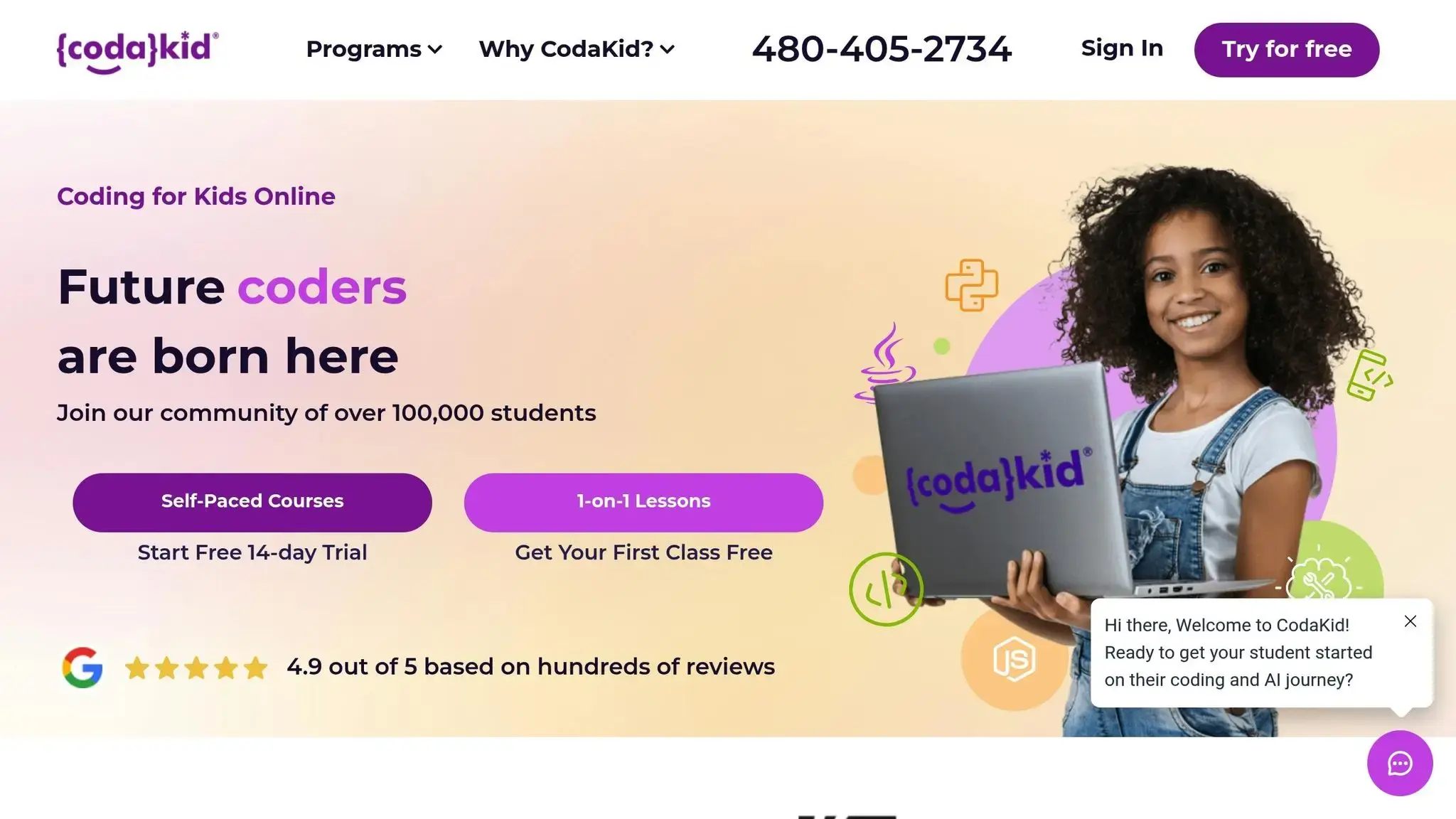
CodaKid offers a range of computer science and AI learning opportunities tailored to homeschoolers. Their offerings include self-paced courses, private one-on-one lessons, and weeklong virtual camps. With over 100,000 students from 140+ countries and a stellar 4.9/5 rating from more than 350 reviews, CodaKid has built a strong reputation for quality education.
Age Suitability
CodaKid’s programs are designed for kids aged 6 to 18. Younger learners can begin with foundational courses like Computer Basics and Scratch Coding. The curriculum is carefully segmented by age and skill level, ensuring that every student – from a 6-year-old exploring Scratch to an 18-year-old crafting games in Unity – is matched with the right content for their abilities and pace.
Key Subjects Covered
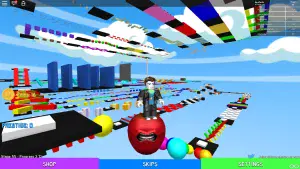
The curriculum covers a wide range of topics, including computer science, AI, robotics, game design, and web development. With 10 learning pathways and over 800 hours of projects, students dive into professional programming languages like Python, JavaScript, Java, Lua, and C#. They can create Minecraft mods, develop Roblox games, and even design AI-powered applications. The AI curriculum touches on important areas like AI ethics, prompt engineering, and AI-driven content creation. Students also use AI tools for coding, debugging, and game development, addressing the gaps in science education often encountered by homeschool families.
Flexibility for Homeschool Schedules (Online Science Camps)
CodaKid offers flexibility to fit homeschool routines. Self-paced courses are accessible 24/7, allowing students to learn whenever it suits them. Virtual camps run for one week, with two-hour daily sessions, while private lessons are scheduled weekly with options for rescheduling. To assist with any technical issues, the platform provides 24/7 online chat and screen-sharing support. Parents can explore the program risk-free through a 14-day free trial for self-paced courses or a complimentary first session for private tutoring.
Hands-On or Project-Based Learning
CodaKid emphasizes hands-on, project-based learning through its “Mastery Method.” Students work with professional-grade tools used by major companies like Google, Facebook, and Intel. These tools include MCreator, Blockbench, Unity, Unreal Engine, and VS Code, giving students a real-world feel for coding and development.
One parent shared their experience:
“My son loves spending time in the program and jumps back in after his schoolwork.”
- Christy Lynn
Pricing begins at $29 per month (or $199 annually, which breaks down to $17 per month). A family plan is available at $45 per month for up to three students. Private one-on-one tutoring starts at $249 per month.
2. Camp Integem
Camp Integem provides engaging online science and technology camps tailored for homeschoolers. With over nine years of experience in STEM education and accreditation from ACS WASC, this program has reached more than 200,000 students across 20+ countries.
Age Suitability
Camp Integem welcomes students aged 6 to 18, offering programs designed to suit various age groups from elementary to high school. For ages 8–13, the Youth Programs emphasize hands-on learning in areas like coding, game design, and artificial intelligence (AI). High School Programs (ages 13–18) delve into advanced topics such as AI, Python courses, college preparation, and portfolio building. Students aged 11 and older can join the Tech Leadership Program to develop leadership skills, while one-on-one sessions for visual learners, including those on the autism spectrum, are available for ages 8 to 18.
Key Subjects Covered
The curriculum spans a wide range of topics, including:
- Artificial Intelligence
- Robotics
- Holographic Augmented Reality
- Coding
- Drones
- 3D Design
- Game Design
- Digital Art and Animation
As an official NVIDIA AI Training Partner, Camp Integem allows participants to earn NVIDIA AI certificates in areas like Generative AI and Robotics. High school students can also earn AP credits through College Board–approved courses. In the advanced three-week program, students even get to launch stratospheric balloons to altitudes between 30,000 and 100,000 feet.
“I am proud that I can code my own AI-powered Holographic AR with Robotics control at the Integem summer camp.” – Zachary T., 15-year-old student
The program’s variety and depth make it a great fit for homeschoolers with different schedules and learning needs.
Flexibility for Homeschool Schedules (Online Science Camps)
Camp Integem accommodates homeschool schedules with year-round live private lessons. These lessons feature customizable pacing and group options for up to six students. The program accepts various funding options, including charter school funding, vouchers, and special needs funds like Regional Center funding for autistic students. To ensure smooth participation, a pre-class setup session is provided to address technical requirements.
Hands-On Project-Based Learning
The program emphasizes practical, project-based learning. Instructors from prestigious universities such as Stanford and UC Berkeley guide small groups (maintaining a 5:1 student-to-instructor ratio) as students work on projects like building smart robots, flying AI-powered drones, and coding interactive 3D AR games.
“I liked Integem camp because I can make AR games and invite my cousin to play with me.” – Alice C., 7-year-old student
Pricing starts at $25 per class for group lessons, $60 per class for private one-on-one lessons, $90 per class for pairs, and $110 per class for groups of 3–6 students.
3. Outschool STEM Camps
Outschool is a massive platform for homeschool science education, offering over 140,000 interactive online science camps for students aged 3 to 18. These classes are split into narrow age brackets – like 5–9, 9–12, and 13–18 – so kids can learn alongside peers at similar developmental stages. From beginner-friendly “How Things Work” sessions to advanced topics like Aerospace Engineering and Quantum Physics, Outschool provides a wide range of engaging and interactive science experiences tailored to different age groups.
Age Suitability
Outschool’s age-specific options make it easier for families to find the perfect fit for their learners. For example, Quantum Academy recently ran a 12-session Space Exploration camp for kids aged 8–12, covering topics like NASA centers, astronaut training in microgravity, and the James Webb Telescope through live video sessions. Another standout was E Square’s five-day Python workshop for ages 10–15, where students tackled hands-on challenges using Python 3.12 and VS Code. With many instructors holding advanced degrees (M.Ed, PhD, or EdD) and earning ratings between 4.8 and 5.0 stars, parents can feel confident in the quality of teaching.
Key Subjects Covered
Outschool STEM camps explore a variety of science and technology topics, including:
- Space & Physics: Aerospace engineering, astrophysics, NASA missions, quantum mechanics, and electromagnetism.
- Technology & Coding: Python programming, game design, and logic-based projects.
- Life & Physical Sciences: Forensic science, biology, chemistry, and even hands-on microscope experiments.
These topics are taught through project-based learning, where students create 3–6 functional projects, such as game simulators and inventory trackers.
Flexibility for Homeschool Schedules (Online Science Camps)
Outschool is designed to fit seamlessly into homeschool routines. Families can choose from intensive one-week camps, three-week courses, or ongoing classes that follow a curriculum [29,32]. Additionally, self-paced “Flex” classes – some starting at just $4 per week – give parents the flexibility to schedule lessons around other daytime commitments. For added convenience, Outschool accepts state funding options like Education Savings Accounts (ESA) and micro-grants.
Hands-On Project-Based Learning
Outschool’s hands-on approach ensures that students actively engage with the material. Many camps encourage learners to build physical prototypes or conduct at-home experiments, bringing science concepts to life. Teachers often use live demonstrations, interactive activities, and guided discussions to simplify complex ideas. With class sizes typically ranging from 3 to 13 students, instructors can offer more personalized attention.
Pricing varies depending on the format. Group live classes generally cost between $30 and $60 per session, while self-paced classes range from $4 to $22 per week. For more extensive year-long STEM programs, sessions are priced around $42–$46 each. Outschool holds a 4.1/5 rating on Trustpilot, based on 3,403 reviews, reflecting its overall positive reception.
4. Science Explorers STEM Camps
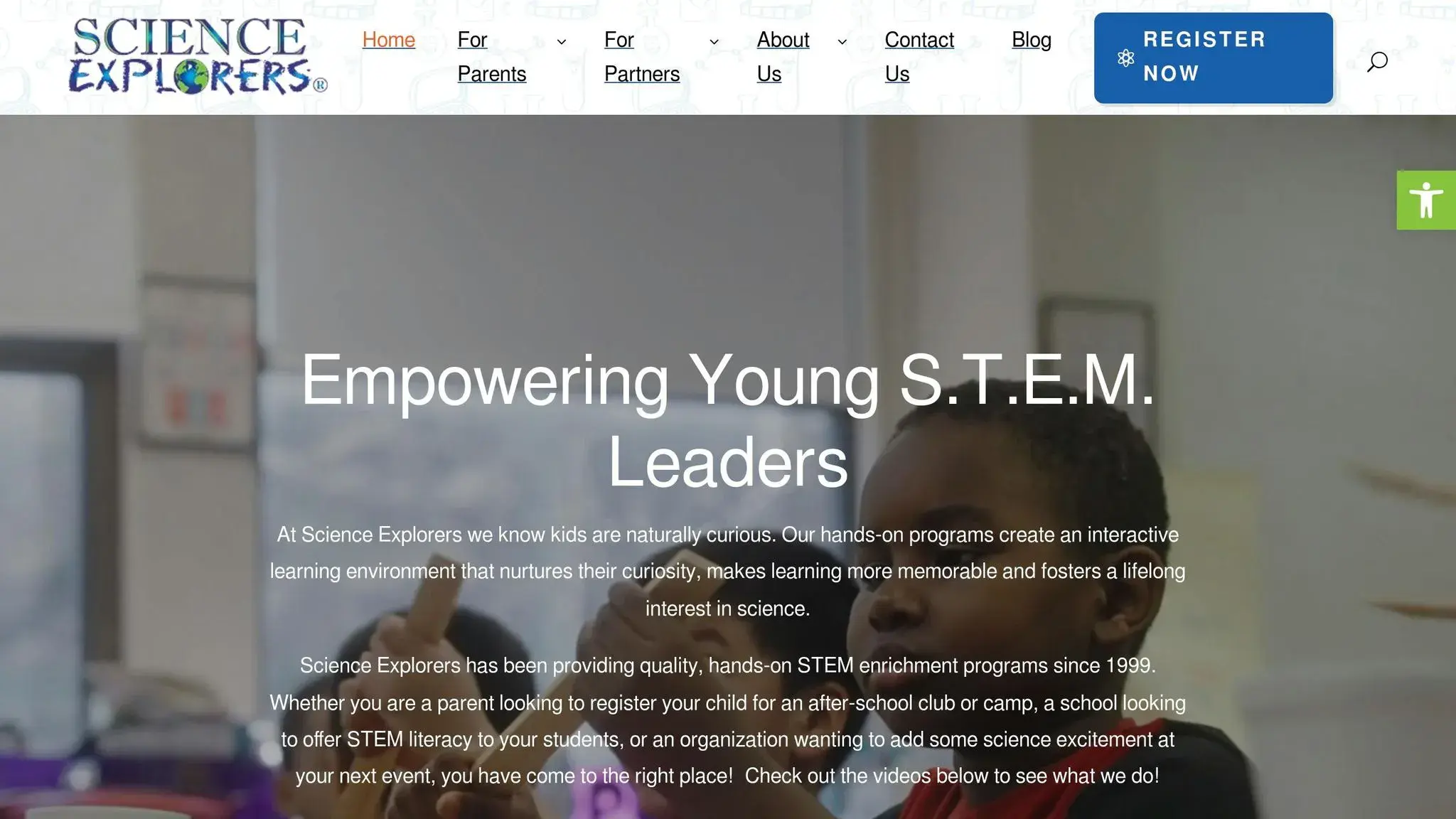
Science Explorers offers virtual STEM camps that bring science to life by delivering physical experiment kits straight to your doorstep. These camps combine hands-on building projects with live online instruction, creating an engaging learning experience. This approach is especially helpful for homeschoolers who want flexible, interactive science lessons. Designed for students in grades 3–8, the camps cover topics like electronics, energy, light, magnetism, inventions, and coding for kids. The sessions are hosted on Zoom and led by trained scientists, ensuring a dynamic and educational environment. Before the camp begins, each participant receives a specially prepared kit and a companion book, so they’re fully equipped for a week of exciting projects.
Age Suitability
Science Explorers caters to a wide age range with two distinct branches. One program is tailored for ages 7–11, with a Jr. Investigative Team option for children aged 4–6. Another program, run by Young Scholars Academy, serves students aged 8–18 and includes options specifically designed for neurodivergent learners. These tailored programs are ideal for twice-exceptional students who thrive with more flexible age groupings. Mark Tidman, a mentor at Young Scholars Academy, emphasizes the importance of this approach:
“Neurodivergent students have the highest level of intelligence, yet they are under-served in almost every classroom”.
Key Subjects Covered
The curriculum dives into a variety of scientific fields, including marine biology (covering oceanography and dissections), physics (motion, electricity, and engineering), chemistry (chemical reactions and chromatography), and space science (rocketry and astronomy). For example, the Energy camp teaches students about kinetic and potential energy by guiding them through building solar racers and electric cars over two week-long modules. The program has even earned praise from Berkeley’s Lawrence Hall of Science for its detailed and engaging companion materials:
“Children learn about every aspect of energy – its various types (e.g. solar, magnetic…), forms (e.g. kinetic vs. potential), and uses”.
Hands-On Project-Based Learning
Each day is structured around a 70–90 minute live Zoom session, followed by an hour of independent experiments. Students tackle projects like generating hydrogen from water, using both the shipped kits and everyday household items. The live sessions provide opportunities for real-time feedback from instructors and peer collaboration, helping students build confidence as they work through each experiment.
This format is ideal for homeschoolers, offering flexibility while maintaining high academic standards. The weekly camp tuition is $150 per session. For those participating in Young Scholars Academy programs, the cost is $30 per day for camps or $46.55 per week for 20-week courses, with a 10% discount available for siblings.
5. College Prep Science Online Science Camps
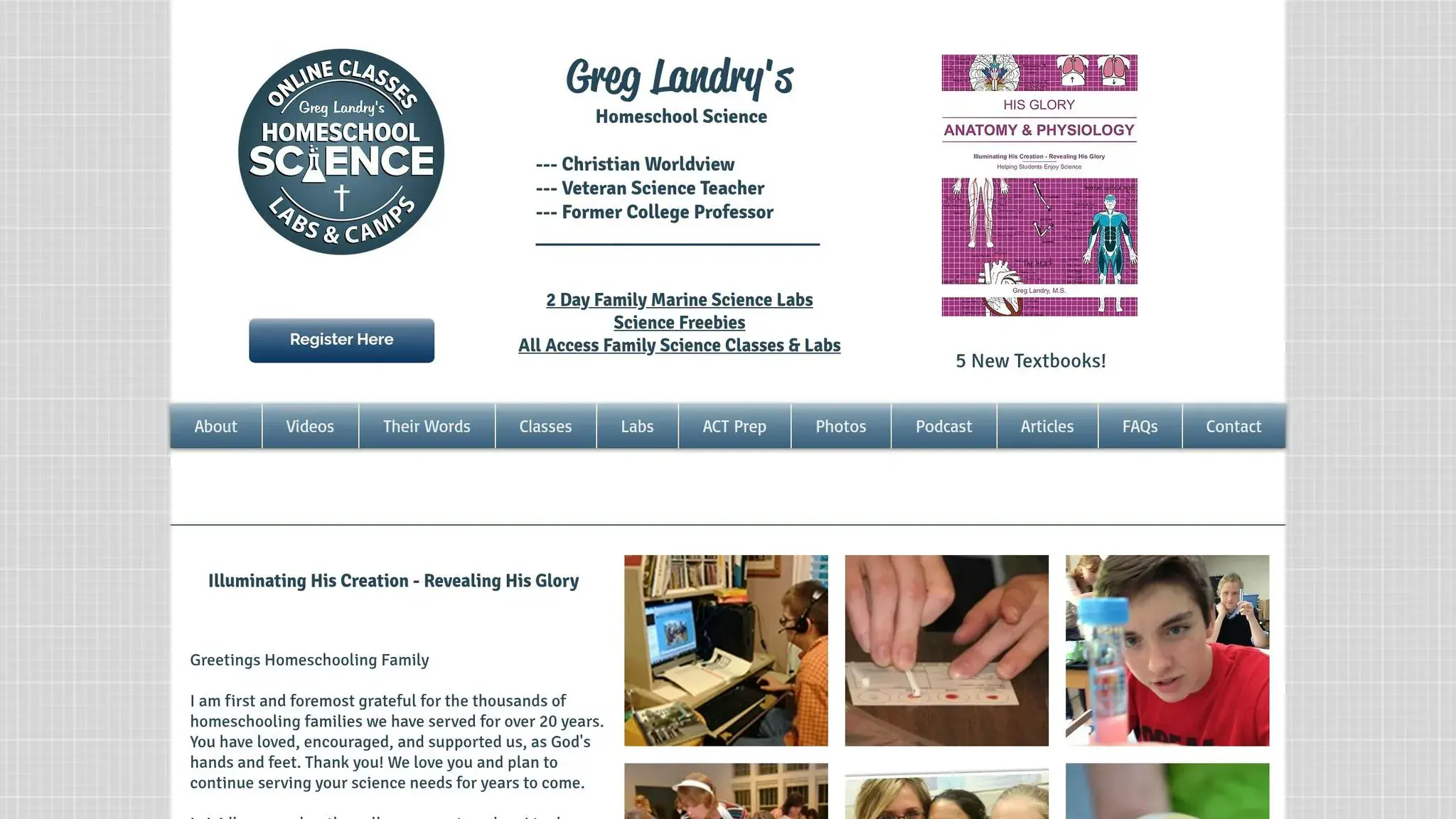
College Prep Science stands out among online science camps for homeschoolers, offering a well-rounded curriculum designed for students in grades 4 through 12. Founded by Greg Landry, a former college professor with over two decades of homeschooling experience, this program has served thousands of families. The coursework is divided into three tiers: Young Scientist Courses (grades 4–7), Pre-High School classes (grades 6–9), and high school options, which include both “Life Prep” and “College Prep” tracks for grades 8–12.
Key Subjects Covered
The program covers essential sciences – Biology, Chemistry, Conceptual Physics, and Anatomy & Physiology – alongside a variety of electives like Marine Science, Biochemistry, Microbiology, Embryology, Exercise & Sports Physiology, and Forensic Science. For younger students, introductory courses such as Pre-Biology, Pre-Chemistry, Pre-Physics, and Pre-Anatomy & Physiology help build a strong foundation for advanced studies.
Greg Landry emphasizes the program’s focus on developing critical thinking through research and inquiry. As he puts it:
“We focus on building critical thinking skills and developing a research and inquiry mindset with the resulting quality lab reports and thinking skills that affect every area of academics and life.”
This curriculum not only teaches scientific concepts but also strengthens analytical and problem-solving abilities.
Flexibility for Homeschool Schedules (Online Science Camps)
The program’s flexible schedule makes it a great fit for homeschool families. Live classes are held weekly for 45–60 minutes, with recordings made available within two hours and accessible 24/7. There’s no penalty for missing live sessions, which is ideal for families managing irregular schedules or living in different time zones. For even greater flexibility, self-paced courses come with one year of family access.
Tuition options include:
- Full-year self-paced classes (grades 8–12): US $180
- Half-year courses (grades 6–9): US $120
- Live online science camps (full year): US $880 (early registration discounts lower this to around US $783).
Hands-On Project-Based Learning
One of the program’s highlights is its interactive virtual labs, which allow students to engage in experiments like pouring liquids, lighting burners, weighing items, and measuring temperatures – all without the need for physical supplies or dissections. Each course includes 10 virtual labs, valued at US $90 but provided free with live classes. This exceeds the six-lab minimum typically required for college-level science courses.
Through these virtual labs, students practice forming hypotheses, collecting data, and drawing conclusions, sharpening their scientific methods and critical thinking skills. These experiences prepare them for the demands of college-level science and beyond.
Parent Carol shared her appreciation for the program’s impact:
“Your training in research and critical thinking has positively influenced how our girls approach academics.”
6. Camp Invention
Camp Invention Connect offers a hands-on STEM learning experience tailored for homeschoolers. This hybrid program combines live online sessions with screen-free, project-based activities, making it a great fit for children in grades K–6. With over three decades of experience inspiring young inventors across the country, the program’s 2026 “Spark” curriculum introduces four captivating modules:
- The Infringers: Dive into cryptography and learn about patent protection.
- Fur-ensics: Explore forensic science and DNA analysis.
- Make Waves: Discover buoyancy concepts and entrepreneurship.
- Space Morphers: Build rockets and experiment with planetary terraforming.
This thoughtful mix of interactive sessions and independent activities aligns perfectly with the needs of homeschool families, offering both structure and flexibility. The program’s comprehensive toolkit ensures every participant is fully equipped for a week of hands-on exploration.
Hands-On Project-Based Learning
Central to Camp Invention is the Innovator’s Toolkit, delivered straight to your doorstep. The kit includes a Maker Mat for workspace setup, a Toolbelt stocked with real tools like screwdrivers, and a Pegboard for organizing parts – everything kids need to dive into their inventions. Each day includes four live sessions (9:00 A.M., 11:00 A.M., 1:00 P.M., and 2:00 P.M.) led by certified educators. In the afternoons, kids work on their projects at their own pace using Inventor Logs, which provide clear, step-by-step instructions. This setup minimizes screen time while maximizing creativity.
“Being able to log in from the comfort of our home allowed us to have a little more control of different sensory issues that might pop up during an in-person program.” – Jessica Stephenson
“The materials were engaging and fun and at the perfect level for my child to feel confident enough to work independently.” – Debbie A.
The program’s structure is designed to fit seamlessly into homeschool routines, balancing guided learning with independent exploration.
Flexibility for Homeschool Schedules (Online Science Camps)
Camp Invention offers homeschool families the freedom to customize their participation. Students can join all, some, or none of the live sessions, making it adaptable to various learning styles and schedules. This flexibility allows K–6 students to progress at their own pace.
“It amazes me how well the curriculum works for kindergarten through sixth grade. Each student is able to excel at their own level.” – Monica G.
The week-long program costs between $235 and $245, which includes all materials and 32.5 hours of engaging curriculum. Studies have shown that just one week of participation can lead to improvements in school attendance, GPA, and test scores over time.
7. Mad Science Online Programs
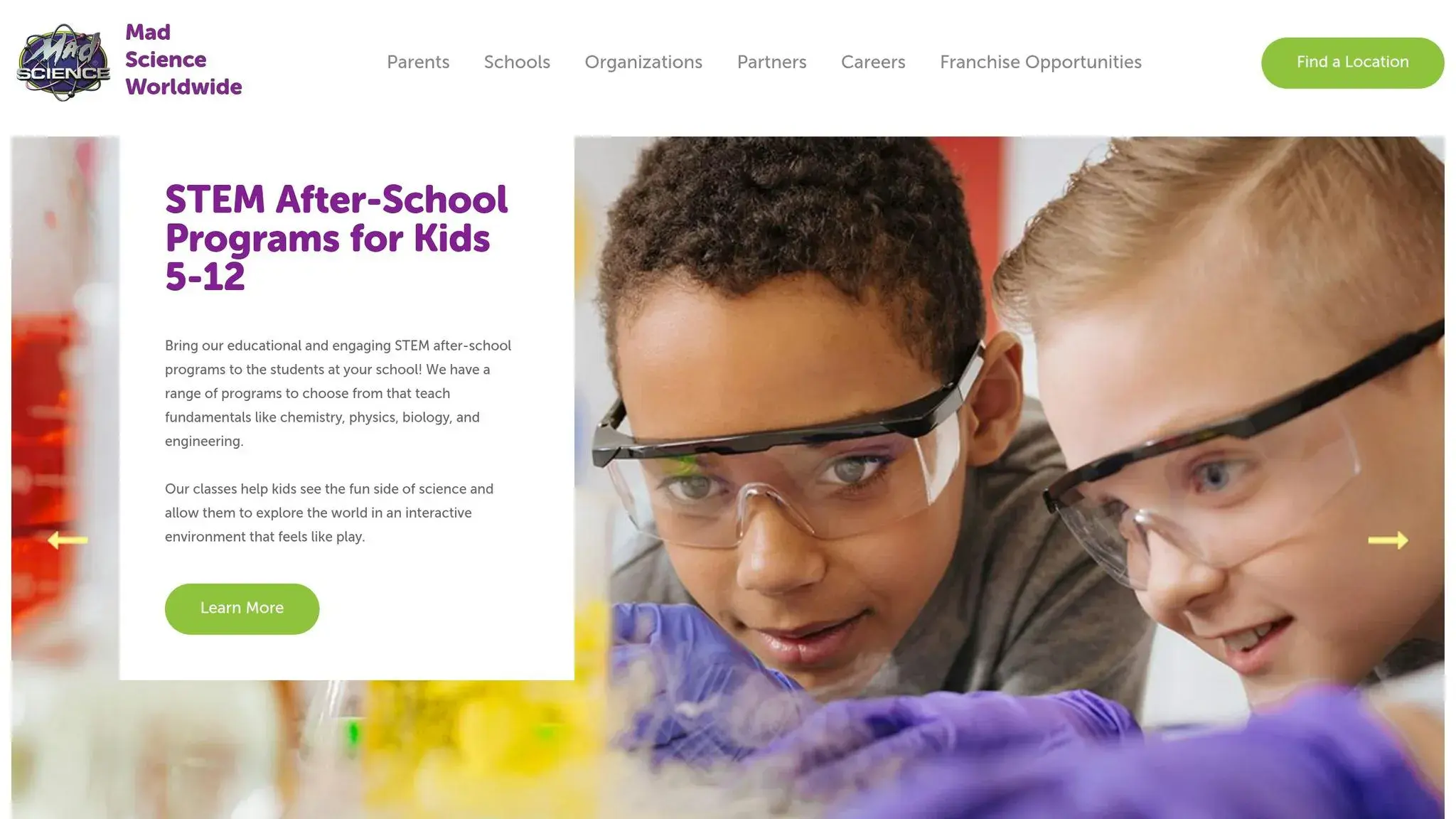
Mad Science offers dynamic virtual classes designed for kids aged 5–12, blending live instruction with hands-on experiments. These one-hour sessions run for 4–6 weeks, with programs like Crazy Chemworks and X-Lab priced around $60 for a full 6-week course.
Key Subjects Covered
The programs dive into a variety of STEM topics, including AI tools for kids, to spark curiosity in young learners. For instance, Crazy Chemworks explores concepts like pH levels, reaction rates, polymers, and states of matter, while X-Lab introduces themes like machines, bugs, movies, and earth science. Another popular option, Sensational Science (for grades 1–5), delves into light, heat, sound, magnets, and nutrition. Classes are conducted live via Zoom, with small group sizes managed by an instructor and moderator.
“My son has attended the Mad Science after-school programs every year starting from Kindergarten! We love how excited he has been after each class to tell us about the cool things his Mad Scientist did!” – Jamie, Parent
Each program encourages kids to engage with science through hands-on experiments they can try at home.
Hands-On Project-Based Learning
Mad Science’s virtual setup emphasizes practical learning through live demonstrations that use everyday household items. Families receive a printable supply list upon registration, ensuring they have everything needed for experiments. After each class, students can explore Home Labs – extra science activities designed to reinforce what they’ve learned. This method makes science both interactive and easy to incorporate into home learning.
“Our son loves science! I am a high school science teacher and love that you give these opportunities for young kids!” – Stacy, Parent
Flexibility for Homeschool Schedules (Online Science Camps)
The program’s flexible scheduling makes it a perfect fit for homeschooling families. Virtual camps offer half-day options in the morning (9:00 A.M.–12:00 P.M.) or afternoon (1:00 P.M.–4:00 P.M.), while Mini Camps provide one- to three-day sessions for even more convenience.
Comparison Table (Online Science Camps)
Here’s a quick side-by-side look at top online science camps to help you find the perfect match for your homeschooler. This table highlights each camp’s standout features, subjects, and costs, complementing the detailed breakdowns provided earlier.
| Camp Name | Age Range | Main Features | Subjects Covered | Pricing |
|---|---|---|---|---|
| CodaKid Virtual Camps | 7–15 years | Self-paced lessons, 24/7 tech support, free trial | AI, Python, JavaScript, game & web development | Starting at $29/month |
| Camp Integem | 6–18 years | Live sessions, small groups, NVIDIA AI certificates | AI, robotics, holographic AR, 3D design, coding | Starting at $25/class |
| Outschool STEM Camps | 3–18 years | Flexible scheduling, live instruction, all ages | Physics, coding, biology, chemistry, space science | $4–$60 per session |
| Science Explorers STEM Camps | 4–11 years | Experiment kits shipped, live Zoom, companion books | Chemistry, physics, biology, marine science | $150 per week |
| College Prep Science | Grades 4–12 | Virtual labs, no physical supplies, weekly live classes | Biology, chemistry, physics, forensic science | $120–$880 per year |
| Camp Invention | K–6th grade | Innovator’s Toolkit, project-based learning | Invention, engineering, cryptography, forensic science | $235–$245 per week |
| Mad Science Online Programs | 5–12 years | Live Zoom, small groups, home labs, supply lists | Chemistry, physics, earth science, nutrition | $60 for 6-week course |
For added peace of mind, many camps offer happiness guarantees or full refunds if the material isn’t a good fit for your child. Some even provide free trials or introductory classes to let your child explore the program before committing financially.
When deciding, think about your homeschooler’s age, interests, and whether they thrive with coding for elementary students or other hands-on activities or virtual labs. Matching their learning style with the camp’s structure can make all the difference!
Conclusion (Online Science Camps)
Picking the best online science camp for your homeschooler means aligning their interests and learning preferences with the right program. These camps are a great solution for parents who might feel unsure about teaching science at home, offering an engaging way to tackle the subject.
Start by matching your child’s age and academic level with programs that fit their needs. Look for options that provide free trial sessions so you can gauge the program’s value before making a financial commitment. Some kids thrive in live, interactive classes with structured guidance, while others prefer the flexibility of self-paced learning. Smaller class sizes – like a maximum of five students per teacher – can also ensure more personalized attention.
Take advantage of free trials and introductory sessions offered by many platforms. These give your child a chance to explore the teaching style and course content before you commit. Short-term classes on platforms like Outschool can also be a great way to test out topics like genetics or astronomy.
Don’t overlook your child’s specific interests. Whether they’re captivated by space exploration, forensics, or marine biology, there are camps tailored to niche subjects. Choosing a program that aligns with their natural curiosity can make the experience more engaging and meaningful.
“Science camps led by experts can help! Learning science increases kids’ overall understanding of how and why things work.”
- Create & Learn
From live lessons to hands-on experiments, these camps are designed to ignite curiosity and develop critical skills. With thoughtful planning, you can turn science into an exciting journey of discovery – building your child’s confidence, problem-solving abilities, and passion for learning.
FAQs (Online Science Camps)
What supplies or software will my child need for online science camps?
Your child will need a computer or tablet, reliable internet access, and any specific supplies or software the camp requires. These might include items like science kits, chemistry sets, microscopes, or access to coding platforms, depending on the camp’s theme. Make sure to review the camp’s supply list to ensure you have everything ready.
How do I pick the right camp level if my child is ahead (or behind) for their age?
When picking a camp level for your child, think about their maturity, experience, and interests. If your child is excelling, consider programs with more advanced or challenging activities to keep them engaged. For beginners or kids who need to strengthen their skills, go for options that focus on building a strong foundation and boosting their confidence.
While age guidelines are helpful, don’t hesitate to adjust based on your child’s unique abilities. The key is finding a program that strikes the right balance between challenge and enjoyment, ensuring they stay motivated and excited throughout the experience.
Can these camps count for homeschool science credit or lab requirements?
Most online science camps designed for homeschoolers typically don’t meet official science credit or lab requirements. However, certain programs – such as self-paced courses or those featuring virtual labs – might provide transcript or semester credits that satisfy homeschool science criteria. It’s always a good idea to review your state’s homeschool regulations or contact the program directly to confirm whether their credits are eligible.