
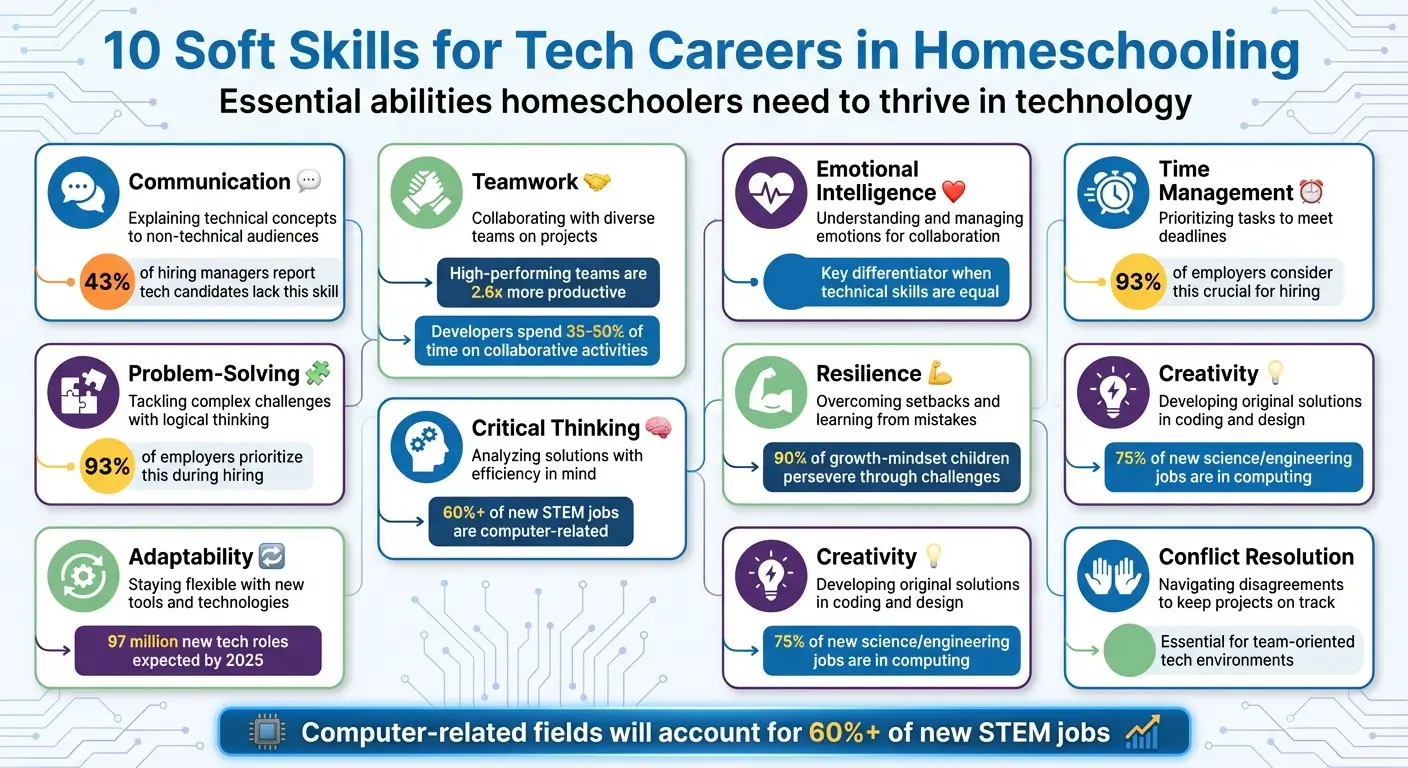
Soft skills are just as important as technical knowledge for anyone pursuing a career in tech – especially homeschoolers. While homeschooling often excels in technical learning, it may lack opportunities to practice teamwork, communication, or conflict resolution. These skills, however, are critical for thriving in the tech industry, where collaboration and problem-solving are key. Here’s a quick overview of the 10 soft skills homeschoolers should develop to stand out in tech careers:
- Communication: Explaining technical concepts clearly to non-technical audiences.
- Teamwork: Collaborating effectively with diverse teams on projects.
- Problem-Solving: Tackling complex challenges with logical thinking.
- Critical Thinking: Analyzing and improving solutions with efficiency in mind.
- Time Management: Prioritizing tasks to meet deadlines without burnout.
- Emotional Intelligence: Understanding and managing emotions for better collaboration.
- Resilience: Overcoming setbacks and learning from mistakes.
- Creativity: Developing original ideas and solutions in coding and design.
- Adaptability: Staying flexible with new tools, technologies, and workflows.
- Conflict Resolution: Navigating disagreements to keep projects on track.
Homeschoolers can build these skills through project-based learning, coding clubs, and online platforms like CodaKid. Structured activities like pair programming, coding challenges, and collaborative projects mimic workplace scenarios, helping students gain practical experience. Developing these 10 soft skills for tech careers early gives homeschoolers a competitive edge in the fast-growing tech job market.
10 Essential Soft Skills for Tech Careers: A Guide for Homeschoolers
Table of Contents
Essential Soft Skills for the IT Professional
1. Communication
In tech roles, communication is essential. Whether you’re working with developers, designers, product managers, clients, or non-technical executives, the ability to explain technical concepts in simple terms can elevate a developer from good to great. Francesca Galbo, Talent Director at Codecademy, emphasizes this point:
“Developers and IT professionals need to be able to communicate clearly and effectively with teammates, clients, and other stakeholders – whether identifying business goals or breaking down technical concepts in a way that’s easy to understand.”
For homeschoolers, honing this skill early can be a game-changer in the tech job market. A striking 43% of hiring managers report that many tech candidates lack strong communication skills, with this issue being especially common among career changers entering the field. This gap presents a chance for homeschoolers to stand out by focusing on communication before launching their careers.
One of the most important aspects of communication is active listening. This means gathering requirements, confirming needs, asking clarifying questions, and summarizing discussions to ensure everyone is on the same page.
Homeschoolers can build these skills with targeted practice. For example, try the Analogy Exercise: explain a complex concept like an API or a coding loop to a non-technical family member in a way they can understand. Another idea is to record yourself presenting a coding project – this helps you spot filler words like “um” or “like.” You could also create a personal tech glossary, using industry terms in sentences to get comfortable with their application. For a more structured approach, joining groups like Toastmasters or presenting at tech meetups (in-person or online) can provide valuable experience.
The goal is to communicate clearly and respectfully. As Galbo points out:
“I’m not saying you have to be an extrovert or have a super bubbly personality. You just need to know how to communicate respectfully with your peers.”

2. Teamwork and Collaboration
Software development is almost never a one-person show. In reality, programmers team up with designers, product managers, QA testers, and fellow developers to tackle complex projects. A McKinsey report highlights this, noting that high-performing software teams can be up to 2.6 times more productive than their lower-performing counterparts, largely due to effective collaboration and communication. On average, professional developers dedicate 35% to 50% of their work time to activities like meetings, code reviews, and pair programming.
For homeschoolers, developing teamwork skills early can provide a competitive edge in the job market. The best part? There are practical ways to build these skills. Activities like peer code reviews, collaborative game testing, or simulated code swaps mimic professional practices and lay a strong foundation for teamwork. These smaller exercises can naturally grow into larger, more structured group projects, further sharpening collaboration abilities.
Assigning Clear Roles and Setting Deadlines
When tackling group projects, assigning clear roles and setting deadlines are critical. This not only ensures accountability but also helps students reflect on their individual contributions. Programming involves a variety of roles – such as programmer, editor, tester, or idea generator – each essential for completing complex tasks. Using task lists allows team members to track progress and know when to seek help.
Virtual platforms also offer homeschoolers opportunities to refine these skills. Online coding communities and virtual hackathons provide real-world collaboration experiences. These spaces are perfect for practicing constructive feedback, a vital skill considering that poor communication is responsible for project delays or failures for 44% of employees. Platforms like CodaKid even offer 2-on-1 lessons, where homeschoolers can bring a friend or sibling into private sessions at no extra cost, fostering a collaborative learning environment. After completing a group project, reflection questions can help students appreciate their peers’ contributions instead of focusing solely on their own efforts. Building these teamwork skills is essential for thriving in today’s tech-driven workplace.
3. Problem-Solving
Problem-solving sits at the heart of tech careers, complementing communication and teamwork. Whether it’s debugging code, fixing network issues, or improving algorithms, the ability to analyze problems and craft effective solutions is crucial. For homeschoolers, this skill holds even greater importance, especially since 93% of employers prioritize these 10 soft skills for tech careers like problem-solving during hiring decisions. As AI takes over repetitive tasks, strong human problem-solving abilities set standout candidates apart.
The tech world demands more than just textbook knowledge – it thrives on hands-on troubleshooting. Developers, for instance, constantly address software bugs, resolve system glitches, and fine-tune code. These skills are best sharpened through practical experience. Homeschoolers can dive into this by tackling coding challenges, creating applications from the ground up, or practicing debugging exercises. These activities not only build technical expertise but also teach how to break down complex problems and experiment with solutions.
“Too often we give children answers to remember rather than problems to solve.” – Roger Lewin, Author and Anthropologist
Practical projects are another excellent way to strengthen problem-solving skills. Platforms like CodaKid offer project-based courses that teach programming through Python, JavaScript, Minecraft modding, and Roblox game development. These courses expose students to real-world coding scenarios that demand logical thinking and persistence. Even dedicating just 10 to 30 minutes daily to coding puzzles or debugging tasks can help establish a solid foundation for problem-solving.
Beyond coding, problem-solving ties directly to other critical skills like adaptability and critical thinking. With computer-related fields projected to make up over 60% of new STEM jobs, homeschoolers who develop strong problem-solving abilities will be ready to tackle the ever-changing challenges of the tech-driven job market.
4. Critical Thinking
Critical thinking takes problem-solving a step further by focusing on objective analysis and fact-based decision-making. In coding, this means evaluating solutions with an eye on efficiency and logical reasoning. For homeschoolers aiming for tech careers, this skill is crucial – especially since computer-related fields are expected to account for over 60% of new STEM jobs.
This mindset encourages inventive approaches to coding and system design. It also involves abstraction, a skill that helps students zero in on the most important details, enhancing both time management and organizational skills. By developing this analytical perspective, students are better prepared for hands-on computational challenges.
Critical thinking builds on earlier problem-solving techniques through exercises that focus on decomposition (breaking down complex tasks), pattern recognition (identifying recurring themes), abstraction (isolating essential data), and algorithmic design (creating step-by-step solutions). For example, when designing a game, students learn to tackle smaller tasks like character design, movement mechanics, and scoring systems instead of trying to handle the entire project at once.
Homeschoolers can practice these principles through activities like keeping a coding journal to document and justify their technical decisions. This habit helps them critically evaluate their solutions. Another effective method is participating in peer code reviews, where students provide constructive, fact-based feedback on others’ work.
“Coding teaches you how to think.” – Steve Jobs
Platforms like CodaKid offer project-based courses in Python, JavaScript, and game development that strengthen critical thinking. These courses simulate real-world coding scenarios, requiring students to analyze problems logically and make thoughtful decisions – key skills for thriving in tech.
5. Adaptability
In a world where technology is constantly advancing, adaptability is more than just a skill – it’s a survival tool. The tech industry is moving at lightning speed, with an estimated 97 million new roles expected by 2025. On top of that, the average person might switch between 15 different jobs throughout their career. With rapid changes like these, many workers will likely need to reskill, especially as AI begins to influence at least 80% of the U.S. workforce by altering 10% or more of their tasks.
“Flexibility and adaptability are vital, with students likely holding around 15 jobs in their lifetime.” – Lisa Nehring, Founder, True North Homeschool Academy
Homeschoolers can develop adaptability through hands-on exploration of various programming languages and technologies. Imagine diving into Python for AI development one month, then shifting gears to JavaScript for web design the next. Maybe even experimenting with Lua for creating Roblox games. This kind of self-paced learning trains students to embrace change rather than shy away from it. It’s a mindset that mirrors the tech world, where professionals are constantly learning and adjusting to new tools and frameworks.
Debugging plays a big role in building this skill. When a piece of code doesn’t work, students have to troubleshoot, analyze the problem from different perspectives, and try new approaches. This process of trial and error encourages the kind of resilience that’s essential for navigating an ever-changing job market.
CodaKid’s self-paced courses in Python, JavaScript, Java, Lua, and C# offer an excellent way for students to explore multiple programming languages and projects at their own pace. This approach not only builds technical skills but also strengthens their ability to adapt to new challenges.
6. Emotional Intelligence
Emotional intelligence (EQ) is about understanding your own emotions and recognizing the feelings of others. In the tech world, EQ blends empathy – the ability to grasp someone else’s challenges – and introspection, which helps you identify your strengths and areas for improvement.
“Recruiters are also looking for candidates with a high sense of EQ – which basically equates to empathy and introspection.” – Francesca Galbo, Talent Director, Codecademy
Why does EQ matter so much in tech? It’s key to creating user-focused designs and building collaborative teams. Homeschoolers can develop EQ through hands-on projects, like designing a game or website for others. These tasks naturally encourage them to think about the end user’s perspective – what could confuse or delight someone interacting with their creation? This mirrors how UX designers approach their work, using empathy to solve user problems. Pairing such projects with active listening exercises can further improve a student’s ability to connect and communicate effectively.
Active listening, a core part of EQ, strengthens empathy by ensuring feedback is fully understood, not just heard. During coding for kids sessions or discussions, encourage kids to tune into the underlying ideas and emotions being shared. This habit fosters respectful dialogue and builds teamwork – skills that can make a big difference in professional environments, especially when technical abilities are evenly matched.
Homeschool settings are ideal for nurturing EQ. Students can openly discuss their learning challenges while engaging in collaborative activities like pair programming or participating in online coding forums. These experiences teach them to share ideas, accept feedback gracefully, and resolve conflicts constructively – all while boosting their emotional intelligence. While technical expertise is vital, EQ and other interpersonal skills round out the toolkit needed to excel in tech roles, supporting better time management and organizational abilities.
7. Time Management and Organization
In tech, mastering time management and staying organized are just as important as technical skills. Whether it’s debugging code, launching a website, or collaborating on a game mod, meeting deadlines while juggling multiple projects is non-negotiable. In fact, 93% of employers highlight time management as a key factor in hiring decisions. When candidates are equally skilled technically, the ability to prioritize tasks and deliver on time often makes all the difference. Paired with teamwork and flexibility, strong time management ensures tech projects stay on track.
Homeschoolers, while benefiting from self-paced learning, need to practice structured time management. For example, when working on Python programming or designing a Roblox game, break the project into clear phases: planning, coding, testing, and debugging. Assign specific time blocks to each phase and use timers to mimic real-world deadlines. Tools like Trello, Google Keep, or Todoist can help homeschoolers divide projects into manageable tasks, track progress, and stay focused. Trello’s visual Kanban boards, for instance, make it easy to move tasks from “To Do” to “In Progress” and finally “Done.” Notion is another great option, blending scheduling with project notes to facilitate collaboration. Dedicating just 10 minutes daily to updating these tools can help build lifelong organizational habits.
Age-Appropriate
Time expectations should also be age-appropriate. For younger kids (ages 6–9), 45-minute sessions twice a week work best, while teens (14+) can handle 60-minute sessions three times per week. As their skills improve, adjust schedules and set specific goals, like completing a level of a Minecraft mod by the end of the week. These habits mirror the demands of tech projects, where poor planning can lead to missed deadlines and burnout.
Activities outside of coding, like clubs, sports, or community groups, also play a role in teaching prioritization. Balancing homework, practices, and personal time mirrors the multitasking required in tech careers. Learning to manage these commitments helps homeschoolers develop the organizational skills needed to handle multiple responsibilities without feeling overwhelmed. These early lessons in prioritization and scheduling give homeschoolers a head start in high-pressure, fast-paced environments.
Online platforms like CodaKid (https://codakid.com) can further reinforce these skills. Their structured coding courses include built-in deadlines that mimic tech industry scenarios, helping students sharpen their time management abilities and prepare for real-world challenges.
8. Resilience
In the tech world, resilience isn’t just helpful – it’s essential. It’s what separates giving up after a frustrating syntax error from growing into a skilled developer. The ability to troubleshoot persistently, known as technical resilience, is critical in an industry that’s always evolving.
The demands of STEM careers often require mental stamina to tackle tough challenges head-on. Resilience, when paired with problem-solving skills, turns setbacks into valuable learning experiences. Homeschoolers, in particular, may have an edge here. When a Python script fails or a Roblox game crashes, it’s not a grade at stake – it’s a puzzle waiting to be solved. As David Dodge, CEO and Founder of CodaKid, puts it: “Coding is not easy. Computer programming requires patience, persistence, and steadfast determination.”
Changing How We View Failure
The first step in building resilience is changing how we view failure. Instead of thinking, “I can’t solve this”, students can be encouraged to think, “I can’t solve this yet.” This small shift reinforces a growth mindset. Research shows that 90% of children with a growth mindset are more likely to persevere through challenges, and 75% of resilient children achieve higher academic success. Debugging becomes more effective when students carefully read error messages, use print statements to track issues, and break problems into smaller, manageable pieces. Tools like Git also help by letting students experiment freely, knowing they can always revert to an earlier version if needed.
It’s important to celebrate the process, not just the result. When a student finally fixes a tricky bug in a Minecraft mod, the focus should be on their persistence and the steps they took to solve the problem – not just the working code. Collaborative techniques, like pair programming with a sibling or friend, also encourage resilience by fostering teamwork and shared problem-solving. As Thomas Edison famously said:
“I have not failed. I’ve just found 10,000 ways that won’t work.”
Platforms like CodaKid are designed to nurture resilience through project-based learning. By using real programming languages and professional tools, their courses give students hands-on experience with the trial-and-error process that’s so common in tech. And with help desk support available for tough roadblocks, learners are encouraged to keep pushing forward, knowing they’re not alone – just like in real tech teams.
9. Creativity and Innovation
Creativity in technology goes far beyond aesthetics – it’s the driving force behind every major advancement. Whether it’s the apps we rely on daily or the games that captivate kids for hours, it all starts with someone imagining something entirely new. In tech careers, creativity empowers professionals to find fresh ways to tackle challenges, streamline processes, and craft innovative coding solutions. It’s what sets apart a developer who simply follows instructions from one who shapes the future of technology.
For homeschoolers, this creative edge is amplified. Without the constraints of rigid classroom schedules, students have the freedom to dive deep into projects that ignite their curiosity. Whether it’s designing a custom Minecraft mod, creating a multiplayer Roblox game, or coding an AI chatbot, the flexibility of homeschooling fosters an environment where original ideas flourish. By moving beyond standard “cookie-cutter” scripts, students can channel their creativity into coding projects that truly express their individuality.
Open-Ended Projects
A powerful way to nurture this creativity is through open-ended projects. Instead of giving step-by-step instructions, educators can set broad goals – like building a game with a scoring system – and let students decide on the theme, story, and design. This approach not only encourages fresh thinking but also reinforces essential programming concepts. CodaKid exemplifies this method with its project-based courses, which use real programming languages like Python, JavaScript for kids, and Lua. Students learn by doing – whether they’re modding Minecraft with Java or creating 3D games in Unity – turning their imaginative ideas into functional code.
Creativity in tech also fuels problem-solving. When a student invents a unique feature for their Roblox game or figures out an inventive solution to a coding issue, they’re developing creative thinking skills that are highly prized in the industry. With nearly 75% of new science and engineering jobs in the U.S. expected to be in computing, and computer-related fields projected to make up over 60% of new STEM jobs, these skills are more critical than ever. Up next, explore how these creative strengths translate into conflict resolution and interpersonal expertise.
10. Conflict Resolution and Interpersonal Skills
Thriving in tech isn’t just about writing great code – it’s about working well with others. The professionals who truly excel are those who can handle disagreements, bring together different perspectives, and keep their teams moving in the same direction. As Jen Goertzen, a design and UX leader, explains:
“There’s a tendency to think that if I show up, and I’m good at writing code, then I’m a good developer. But the people I’ve seen promoted are those who help to move the work forward. That comes from multiple people working in concert.”
Conflicts in tech often stem from misunderstandings or a lack of shared context. For example, a developer’s technical decisions might not make sense to a designer, or engineers and product managers might use completely different terminology. Addressing these challenges requires active listening and clear communication. Peer reviews are particularly useful in bridging gaps, as they help uncover subtle differences in technical perspectives. These skills build on the teamwork strategies discussed earlier.
Fostering collaboration starts with assuming positive intent. Imagine a coding club where members have conflicting ideas about a project’s direction. Taking a moment to refocus on the shared goal can help realign everyone. Homeschoolers can practice resolving such conflicts in coding clubs – whether through local homeschool groups or platforms like CodaKid – by emphasizing shared objectives and constructive dialogue. When disputes escalate, a neutral mentor can step in to mediate and keep the project on track.
Considering that computer-related fields are projected to account for over 60% of new STEM jobs, these interpersonal skills are more than just nice to have – they’re critical for long-term success. Developing these abilities ensures homeschoolers are ready to thrive in dynamic, team-oriented tech environments.
How to Build These 10 Soft Skills for Tech Careers in Homeschool Settings
Developing the 10 soft skills for tech careers in a homeschool environment equips students not just to excel in coding but also to thrive in team settings and tackle complex tech challenges. Homeschooling’s flexibility makes it easier to weave these skills into technical projects. One standout method is project-based learning, where students can hone research, writing, and organizational skills while diving into technical topics. For instance, creating Minecraft mods or designing Roblox games encourages systems thinking and builds an awareness of how individual components influence an entire system.
This approach also naturally fosters collaboration, a key soft skill. Activities like pair programming with siblings or friends improve communication and problem-solving as students share strategies and explain their thought processes. Expanding this collaboration to online coding communities, such as Discord groups or forums, introduces students to a broader support network, offering both technical advice and emotional encouragement during tough learning moments.
Structured Learning Options
Structured learning options further strengthen soft skills. For example, platforms like CodaKid provide a variety of formats, including self-paced courses (starting at $29/month), private 1:1 lessons ($249/month), and virtual camps. These programs cover over 85 courses in areas like AI, Python, JavaScript, and game development with real-world programming languages. This is especially relevant since 62% of employers prioritize problem-solving abilities when hiring for tech roles.
Daily habits can also play a big role in developing these skills. Weekly family planning sessions, where everyone reviews schedules and priorities, teach time management and help students balance multiple commitments. Encouraging students to compile their work into a GitHub repository or personal website builds documentation and presentation skills, which are directly applicable in professional settings.
To improve focus and self-assessment, techniques like the Pomodoro Method are highly effective for breaking down complex coding tasks. Keeping a learning journal where students track challenges and solutions sharpens metacognitive skills and fosters self-awareness. Setting SMART goals (Specific, Measurable, Achievable, Relevant, and Time-bound) ensures projects stay on track. For example, a goal like “Write three Python functions for a calculator by Friday” provides clear direction. Combined with hands-on coding projects, these strategies position homeschoolers to take advantage of the 97 million new tech roles expected by 2025.
Conclusion (10 Soft Skills for Tech Careers)
Homeschoolers aiming for tech careers need more than just coding know-how to succeed. ByCode Guide puts it perfectly: “A successful coding career is not solely dependent on technical competence. It requires a well-rounded skill set, including strong soft skills, to thrive in the ever-evolving tech landscape”. The ability to explain complex ideas, collaborate with diverse teams, and keep pace with rapid technological shifts sets successful professionals apart from those who struggle to grow.
The numbers back this up – tech careers now place a high value on blending technical expertise with interpersonal skills, offering great opportunities for homeschoolers who develop both. Strong communication skills help bridge the gap between coding and business needs, while traits like emotional intelligence and conflict resolution elevate coders into leaders capable of driving projects forward.
This mix of skills gives homeschoolers a real advantage in today’s team-driven job market, where technical knowledge alone isn’t enough to stand out. Abilities like problem-solving, critical thinking, and organization also translate well into college, social interactions, and any career path students choose to follow.
Parents can help by blending soft skill development with technical training early on. Teach debugging as a way to turn mistakes into learning moments, encourage participation in coding clubs or hackathons, and connect students with experienced developers who can model professional communication. When homeschoolers combine technical skills with polished interpersonal abilities, they position themselves to thrive in a tech industry that’s growing at breakneck speed.
Start building these skills today. At CodaKid, our programs are designed to teach coding while fostering the 10 essential soft skills for tech careers, giving students the tools they need to succeed. The tech world rewards those who can write great code and collaborate effectively to bring bold ideas to life.
FAQs (10 Soft Skills for Tech Careers)
How can homeschoolers practice teamwork without a classroom?
Homeschoolers can develop teamwork skills by participating in group activities and working on collaborative projects with other homeschooling families. These experiences allow kids to practice working together, strengthen their communication abilities, and appreciate different viewpoints. It’s a great way to create a sense of a shared learning environment outside a traditional classroom.
What are simple ways to build communication skills for tech?
Clear communication is a game-changer in the tech world. To get better at it, start by practicing how to explain complex ideas in simple terms. Imagine you’re breaking down a technical concept for someone without a tech background – this helps you refine your clarity.
Another key? Active listening. Pay attention to what others are saying, ask follow-up questions, and confirm your understanding. This not only builds stronger connections but also ensures smoother collaboration.
Team projects are a great way to sharpen communication skills. Presenting work or brainstorming in groups builds your ability to articulate ideas clearly and engage effectively with others. Plus, encouraging curiosity and teamwork creates an environment where open dialogue thrives, making problem-solving easier and more collaborative.
Strong communication isn’t just a “nice to have” – it’s essential for thriving in coding and tech careers.
How do I show soft skills in a tech portfolio?
Showcase soft skills in your tech portfolio by highlighting teamwork, clear communication, and strong problem-solving abilities in real projects. Highlight collaborative projects where teamwork played a key role, and clearly outline your contributions. Show your ability to explain technical concepts in a way that’s easy to understand – this demonstrates strong communication skills.
Additionally, include examples where you tackled tough challenges, detailing the steps you took to find solutions. A well-organized portfolio showcasing projects and collaboration helps employers recognize your soft skills alongside your technical expertise.